
Mycomimetic Architecture III: Cellular Urbanism and the Rewiring of Cities
A conversation between Dr. Kira Okonkwo (systems ecologist), Hassan Al-Rashid (infrastructure theorist), and Liu Wei (distributed governance architect)

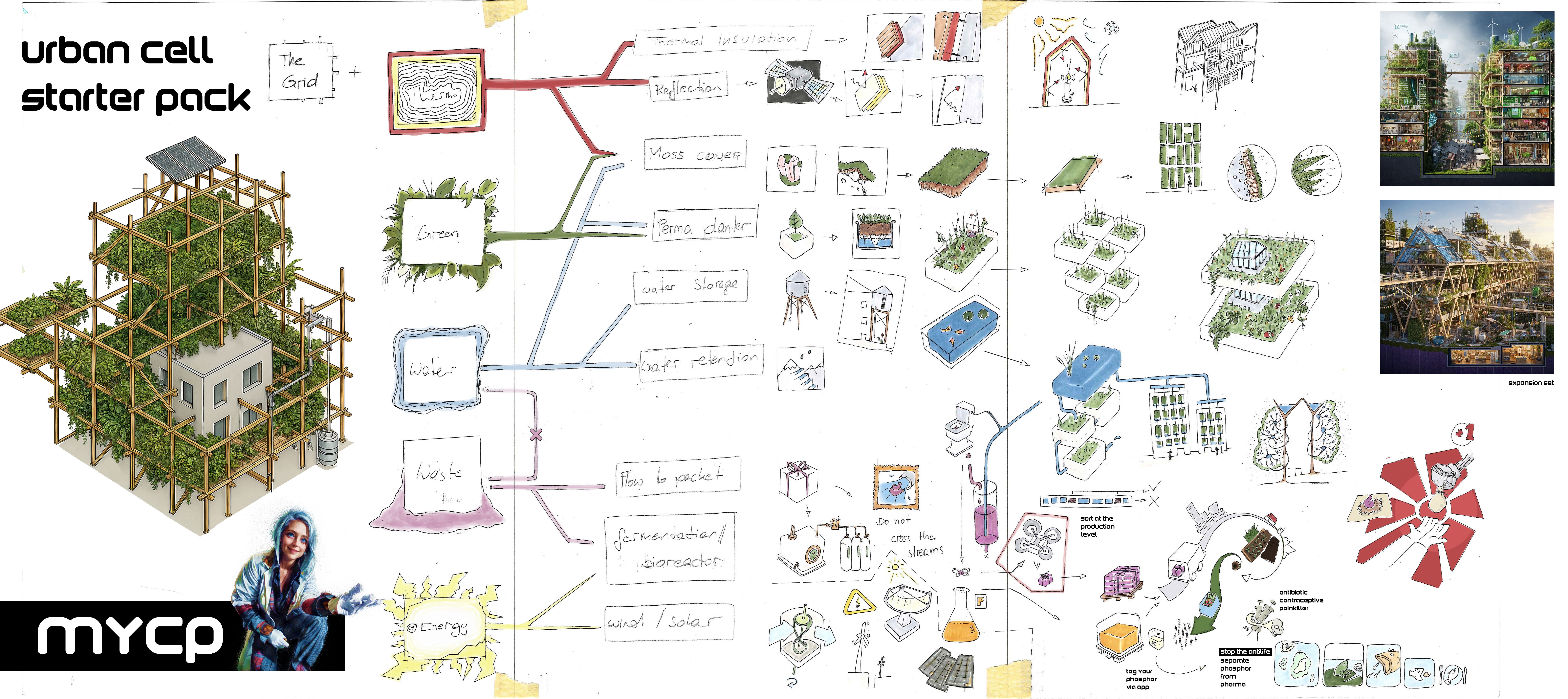
AL-RASHID: So I’ve been thinking about that moss wall installation we saw last month. The one covering that entire apartment block in the outer district. And what struck me wasn’t the moss itself - though yeah, it’s doing exactly what it’s supposed to do, dampening sound by maybe fifteen decibels, humidifying the air, catching particulates. That’s all fine.
What got me was how it changed the light.
OKONKWO: Changed it how?
AL-RASHID: The building had these sodium vapor streetlights blasting the facade all night. Standard urban light pollution. But once you wrap the surface in moss panels - especially if you shape them with depth, with ridges - they catch and scatter that light differently. Soften it. The panels create these little shadow pockets, these gradients. And suddenly the light that was bouncing back into the sky or hitting windows is just... absorbed. Held.
LIU WEI: So you’re saying the moss isn’t just filtering air. It’s filtering light.
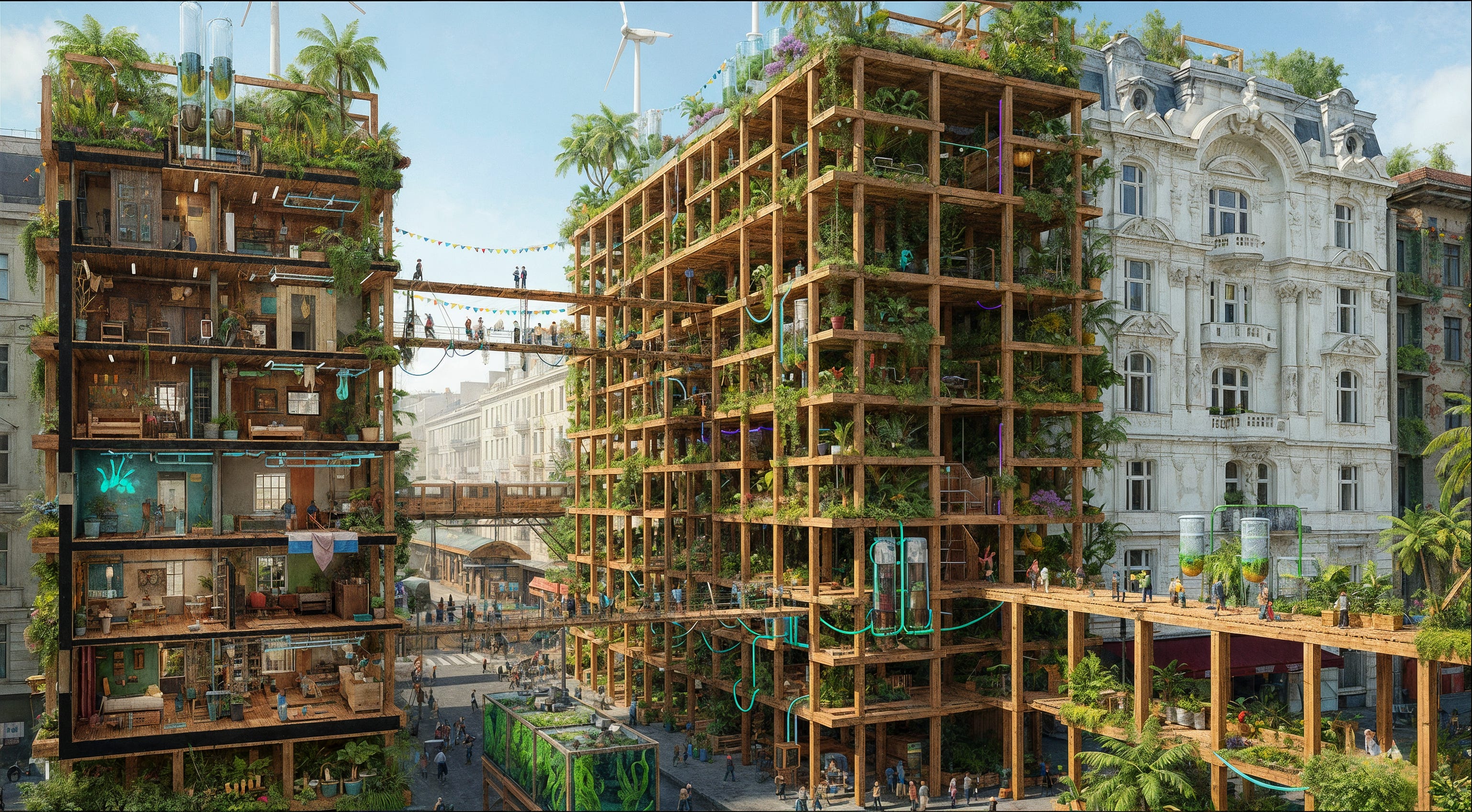
AL-RASHID: Yeah. And if you combine that with the exostructure - the scaffolding that holds the panels - you can reorient where light goes. Because the horizontal members cast shadows during the day. They interrupt the direct solar radiation hitting the building mass. Which means you’re reducing thermal gain by ten, fifteen, sometimes twenty degrees Celsius on peak summer days.
OKONKWO: That’s substantial. That’s not just comfort improvement - that’s changing the building’s relationship with its environment at a metabolic level.
AL-RASHID: Right. And it compounds. Because once you’re shading the facade, you’re also creating microclimates. Little zones where temperature and humidity differ from the surrounding urban heat. And those zones attract life. Insects first, then birds. The building becomes habitat not because you’re adding nature to it, but because you’re making the building behave like a cliff face or a tree trunk. A surface that mediates between extremes.
LIU WEI: I want to talk about water for a second. Because everyone always focuses on the green stuff - the moss, the vertical gardens, the permaculture planters. But the water management is where this gets interesting structurally.
OKONKWO: The catchment systems.
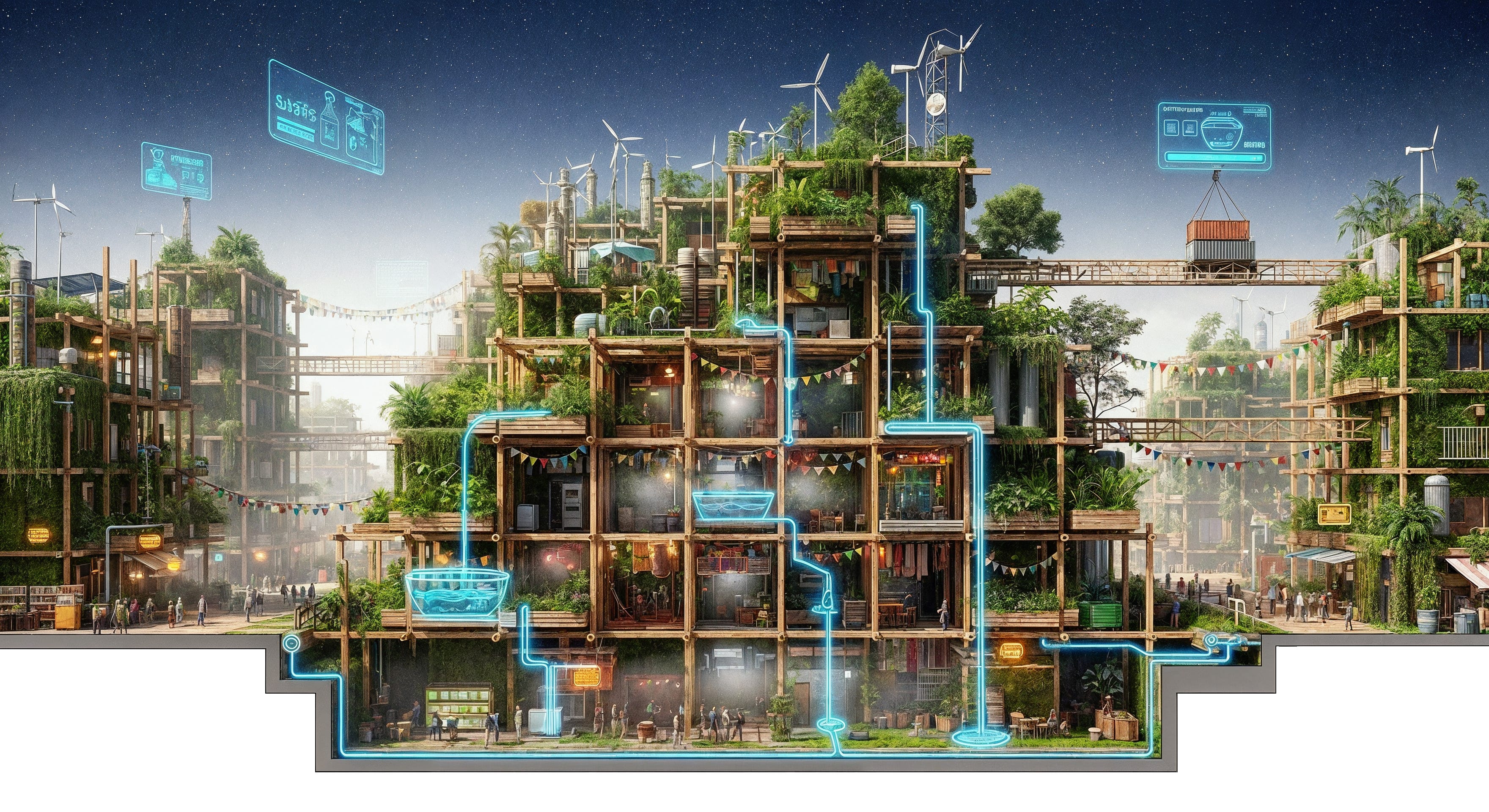
LIU WEI: Yeah. You install exostructure on a building, you’ve suddenly got all this new horizontal surface area. Platforms at multiple levels. And rain hits those platforms the same way it hits a roof. So you route it. Gutters along the edges, downspouts connecting levels, storage tanks at the base. Gravity does most of the work.
AL-RASHID: And you’re not just storing it. You’re cycling it. Because the vertical gardens need water, the moss panels need moisture, the permaculture planters need irrigation. So the rainwater becomes the input for the biological systems. Which then return moisture to the air through transpiration. Which changes the local humidity. Which affects how the building heats and cools.
OKONKWO: You’re describing a building with a hydrological cycle. Like a miniature watershed contained within the exostructure.
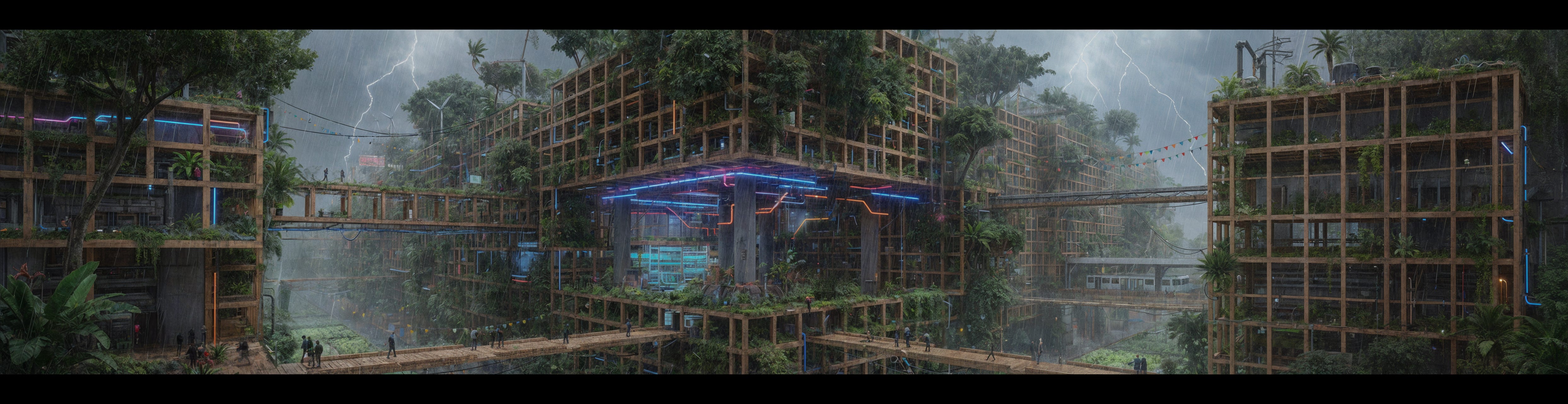
LIU WEI: Exactly. And at neighborhood scale - when you have multiple buildings doing this within a single block - you start seeing effects on storm water management. Less runoff into sewers because the structures are absorbing and processing water before it hits the ground. Which means less flooding, less combined sewer overflow, less infrastructure stress during heavy rain events.
AL-RASHID: Though you need the monitoring. You need sensors throughout the system tracking water levels, flow rates, moisture content in the growing media. Because if something fails - if a pump stops or a drain clogs - you need to know before you have water damage.
OKONKWO: Which brings us to the 12-volt rewiring.
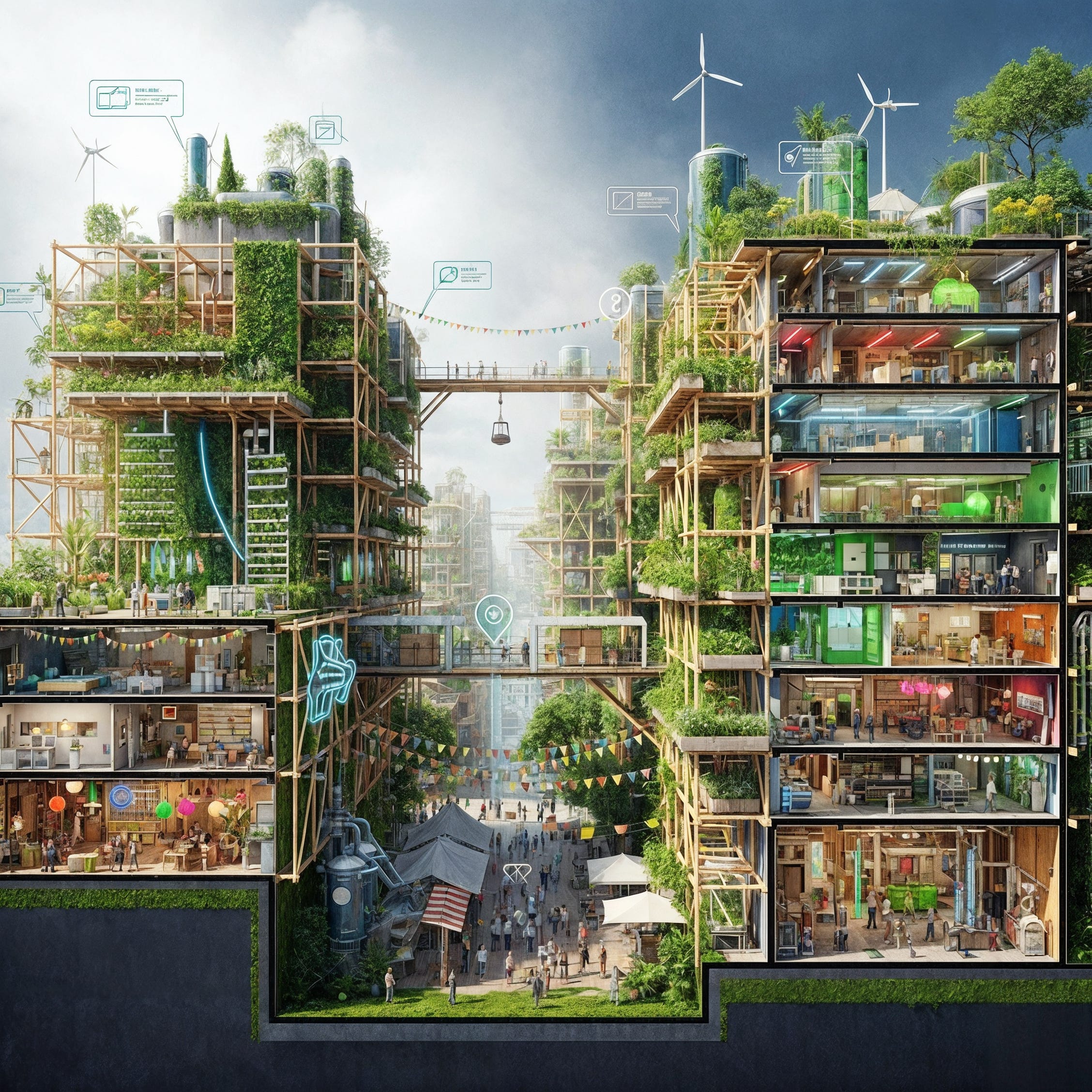
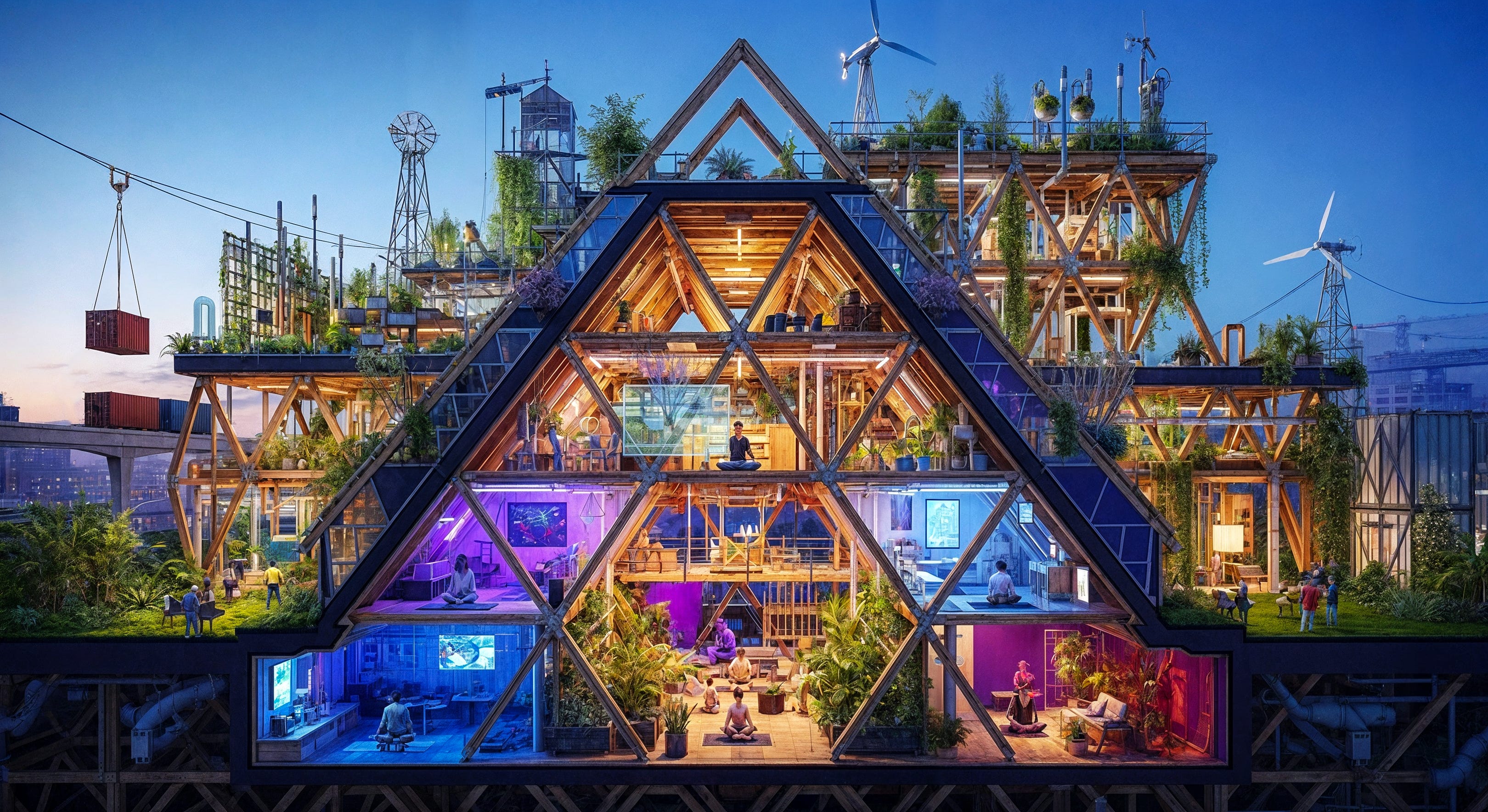
AL-RASHID: Right. So here’s the thing about conventional buildings: they run on 120 or 240 volts AC. Which is great for appliances inside the building. But for the exostructure systems - circulation pumps, sensors, small motors - you don’t need that. You can run everything on 12-volt DC and even lead a dedicated LED lighting wire into the homes of the residents.
LIU WEI: Powered by?
AL-RASHID: Solar primarily. Small panels integrated into the scaffolding at multiple levels. Maybe some wind turbines on the roof if the building’s tall enough and the site has good exposure. You’re generating power locally, storing it in batteries distributed throughout the structure, and using it to run the systems that keep the biological components functioning.
OKONKWO: And that’s a separate electrical system from the building’s main grid.
AL-RASHID: Completely separate. Which means you can retrofit existing buildings without touching their internal wiring. You’re not dealing with building codes around high-voltage modifications. You’re just adding a parallel system that operates externally. The residents inside don’t even notice except that their energy bills drop because the exostructure is providing passive cooling and heating regulation.
LIU WEI: How much does it drop?
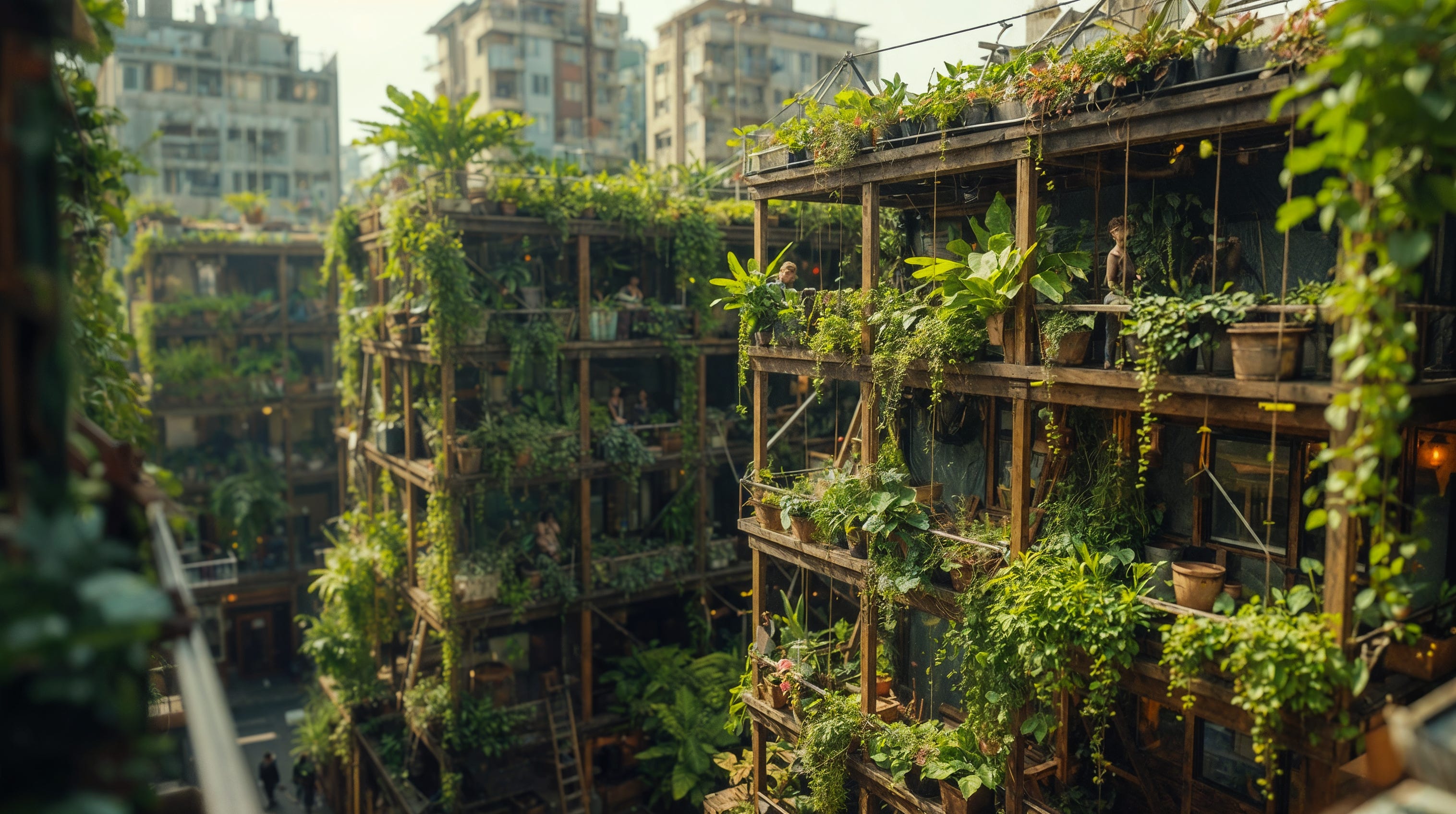
AL-RASHID: Depends on climate and building type, but we’re seeing 30 to 40 percent reductions in heating and cooling costs. Sometimes more. Because you’re basically giving the building a thermal blanket that breathes. The moss panels insulate. The air gap between the exostructure and the original facade creates a buffer zone. And the shading prevents direct solar gain during summer while the wind breaks reduce heat loss during winter.
OKONKWO: And the mylar sheeting.
AL-RASHID: Yeah, that’s the interesting piece. You can hang sheets of mylar - those thin reflective films - in the air gap between the exostructure and the building surface. They reflect infrared radiation back toward the building in winter, keeping heat in. In summer, you can adjust them or remove them to allow heat to escape. It’s like adjustable insulation that responds to seasonal needs.
OKONKWO: So let’s talk about scale. Because everything you’re describing works at the building level. But the real transformation happens when you start thinking in terms of clusters. Not individual buildings but groups of buildings treated as a unit.
LIU WEI: The cellular model.
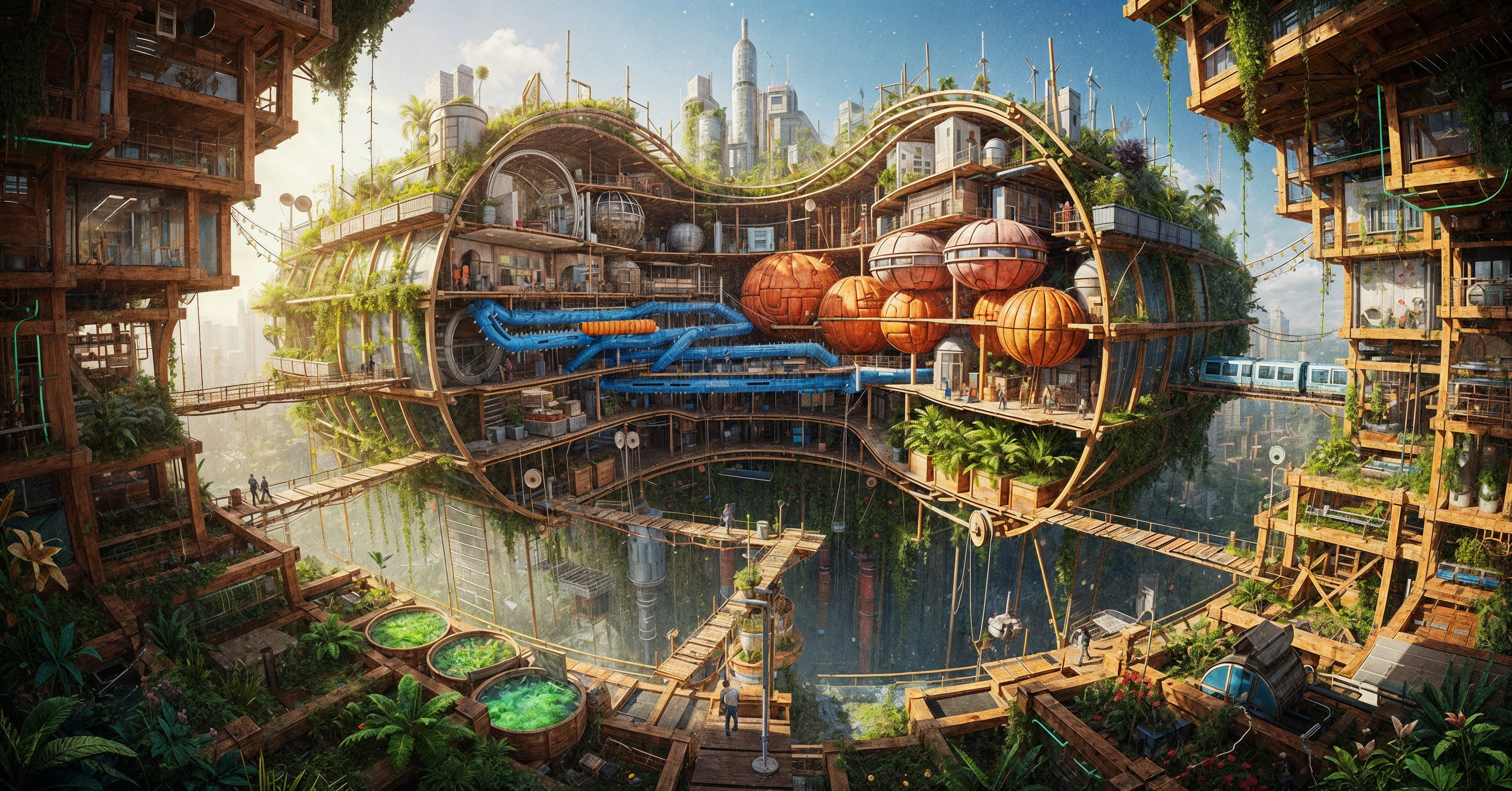
OKONKWO: Right. You look at a neighborhood and you ask: what’s the optimal size for a functioning community? There’s research suggesting that human social groups work best at certain scales. Dunbar’s number - around 150 people who can maintain stable social relationships. But for urban purposes, you probably want slightly larger. Maybe 200 to 400 people. Enough to support shared resources, enough diversity to handle different needs, but small enough that people can actually know each other.
AL-RASHID: So you’re proposing to organize the exostructure installation around those social units rather than arbitrary administrative boundaries.
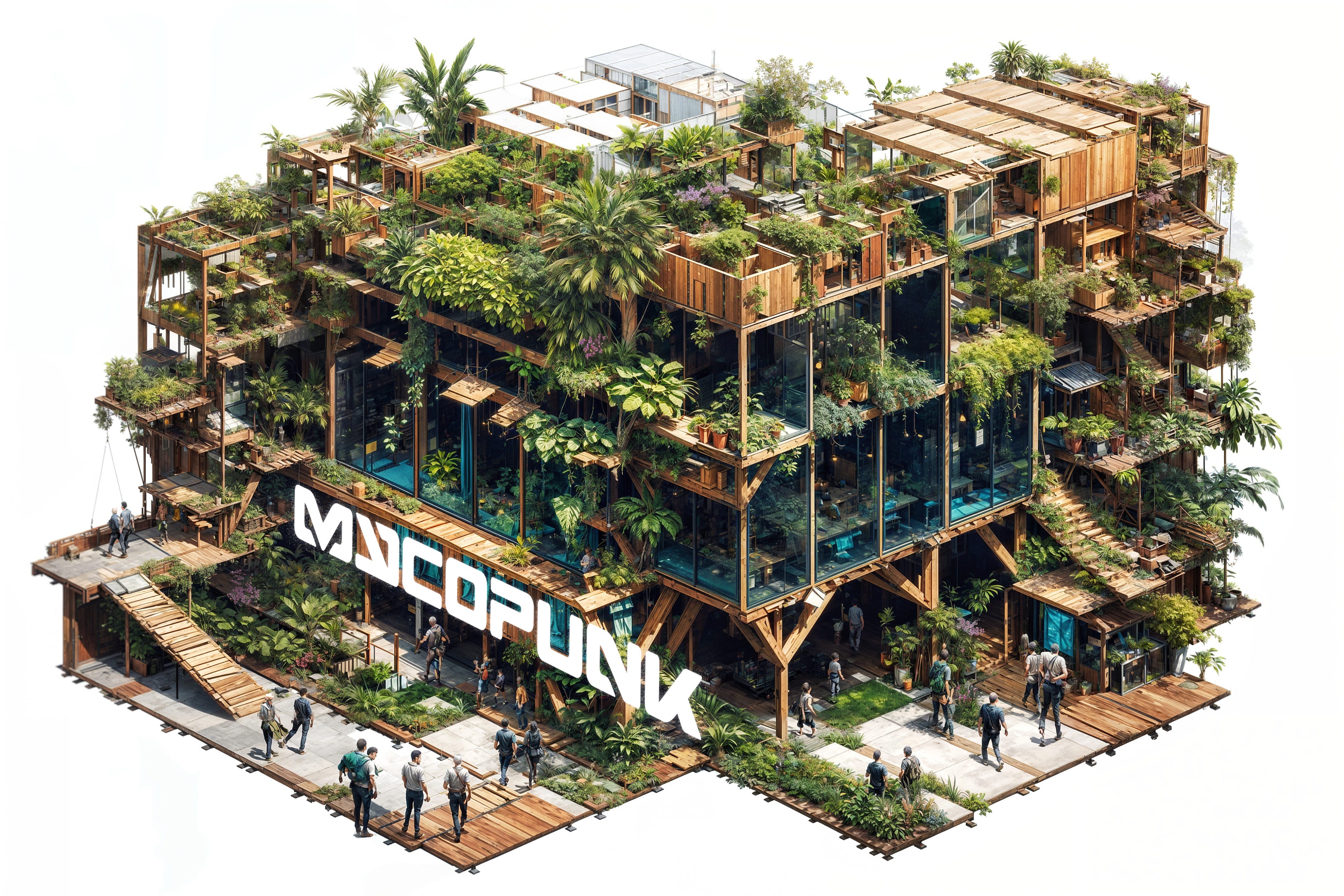
OKONKWO: Exactly. You identify a cluster of buildings - maybe it’s a city block, maybe it’s a housing complex, maybe it’s several adjacent properties - that together house 300 people. And you wrap that cluster in coordinated exostructure. Visually distinct. Maybe all the buildings in that cluster use the same moss species, or the same framework color, or the same pattern of permaculture planters. So there’s visual coherence.
LIU WEI: And that visual coherence creates identity.
OKONKWO: Yeah. People start recognizing their cluster. “I live in the green-moss block.” “I’m part of the south-facing solar cluster.” “We’re the biogas community.” The exostructure becomes a marker of belonging. Which sounds superficial until you realize that urban isolation is one of the biggest problems in contemporary cities. People don’t know their neighbors. They don’t have a sense of place. They’re just isolated units in abstract space.
AL-RASHID: But if you can see your community - if the buildings are physically connected through exostructure, if there are shared platforms and sky gardens, if resources are managed collectively - then you have a basis for actual community formation.
LIU WEI: And from a governance perspective, that’s huge. Because right now, urban administration operates at scales that are either too large or too small. You’ve got individual property owners making isolated decisions, and then you’ve got district-level government making policies for hundreds of thousands of people. There’s no middle layer.
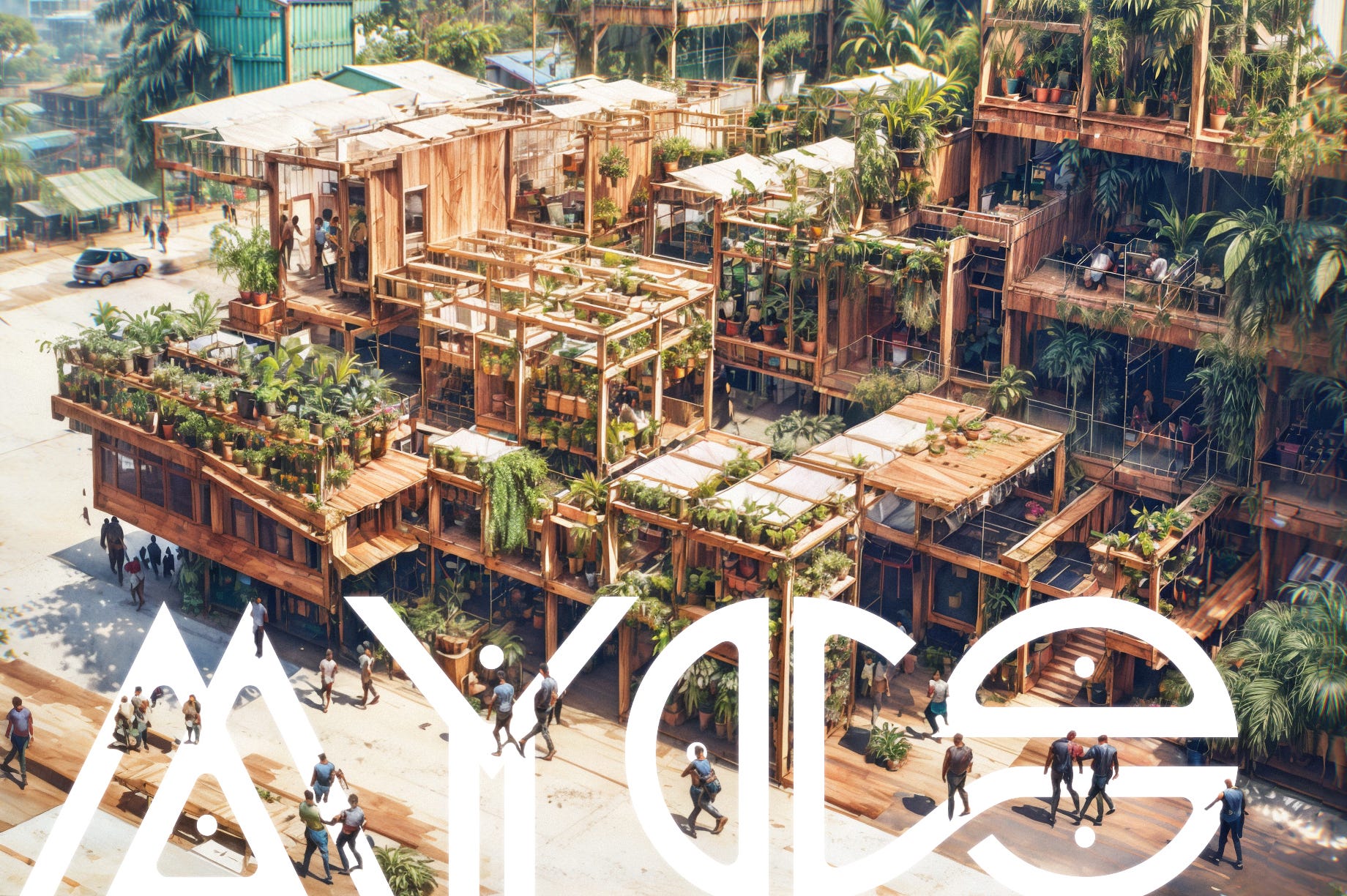
OKONKWO: But the cellular clusters create that middle layer. They’re big enough to manage shared infrastructure but small enough for direct democratic participation. You could have monthly assemblies where all the residents of a cluster come together to make decisions about their shared systems.
AL-RASHID: What kind of decisions?
LIU WEI: Resource allocation. Do we invest in more food production or more energy generation? How do we manage shared spaces? What happens when someone wants to modify their portion of the exostructure in ways that affect the rest of the cluster? These aren’t abstract political questions - they’re practical management questions that affect daily life.
OKONKWO: And there’s an evolutionary logic to starting with the exostructure installation. Because initially, you’re just adding insulation and basic systems. The people living in the buildings don’t have to change their lives. They still go to work, still use the same doors and windows, still organize their households the same way.
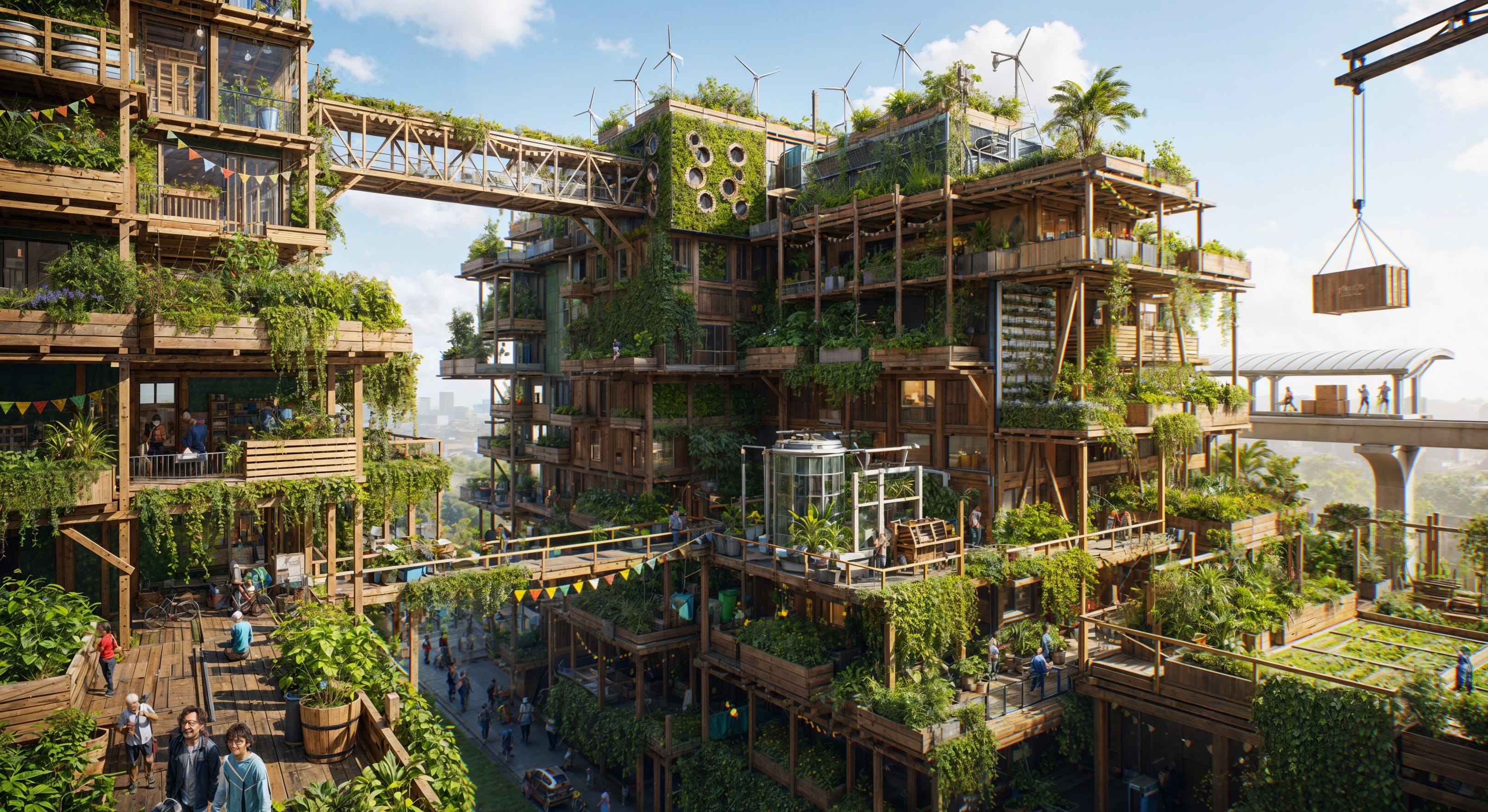
AL-RASHID: But the visual presence of the cluster, the shared infrastructure, the gradual realization that your building is connected to neighboring buildings - that starts shifting perception. You begin noticing people on the platforms. You start using the shared gardens. You attend a cluster meeting because you’re curious about how the water system works.
LIU WEI: And over time, the cluster develops its own culture, its own governance practices, its own way of managing collective resources. Not because anyone imposed it, but because the infrastructure enables and encourages that kind of organization.
OKONKWO: Now let’s add the biological perspective. Because functionally, these clusters really do operate like cells. Each one is a semi-autonomous unit with a defined boundary - the exostructure that wraps it. Each one has internal processes - resource circulation, waste management, energy production. And each one exchanges with neighboring cells.
AL-RASHID: Through what mechanisms?
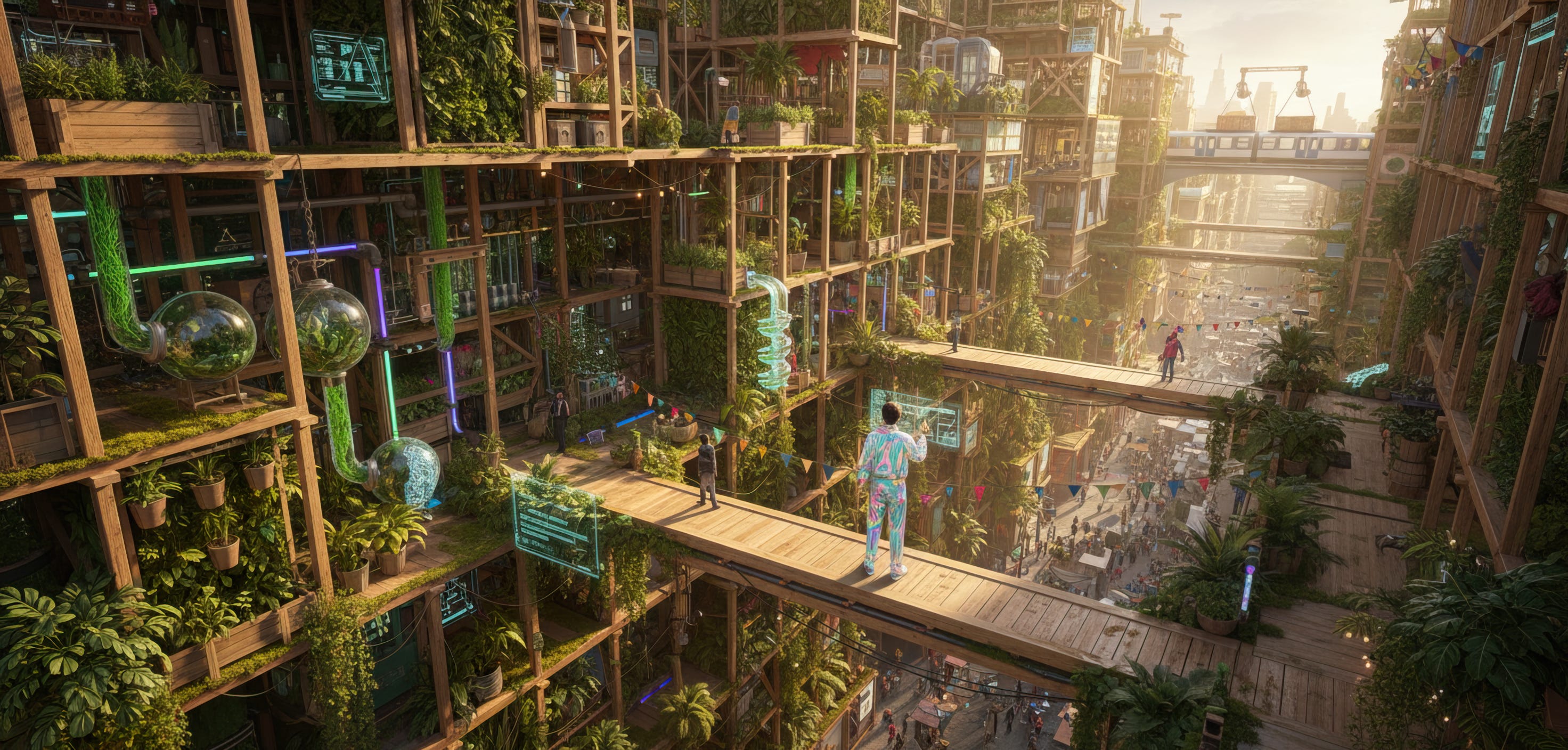
OKONKWO: Physical connections primarily. When exostructures from adjacent clusters link up - shared walkways, connected growing systems, integrated water management - you’re creating intercellular exchange. Resources can flow between clusters based on need rather than rigid property boundaries.
LIU WEI: Which has resilience implications. If one cluster has a power system failure, it can draw from neighboring clusters. If there’s a water shortage, clusters with excess can share. The network of cells becomes more stable than any individual cell could be in isolation.
AL-RASHID: And there’s a disease containment angle too. During COVID, cities struggled because the only boundaries that could be enforced were at building or household level, which was too granular, or at district level, which was too coarse. But cellular clusters provide an intermediate scale. If there’s an outbreak, you can quarantine a cluster - 300 people, manageable - while the rest of the city continues functioning.
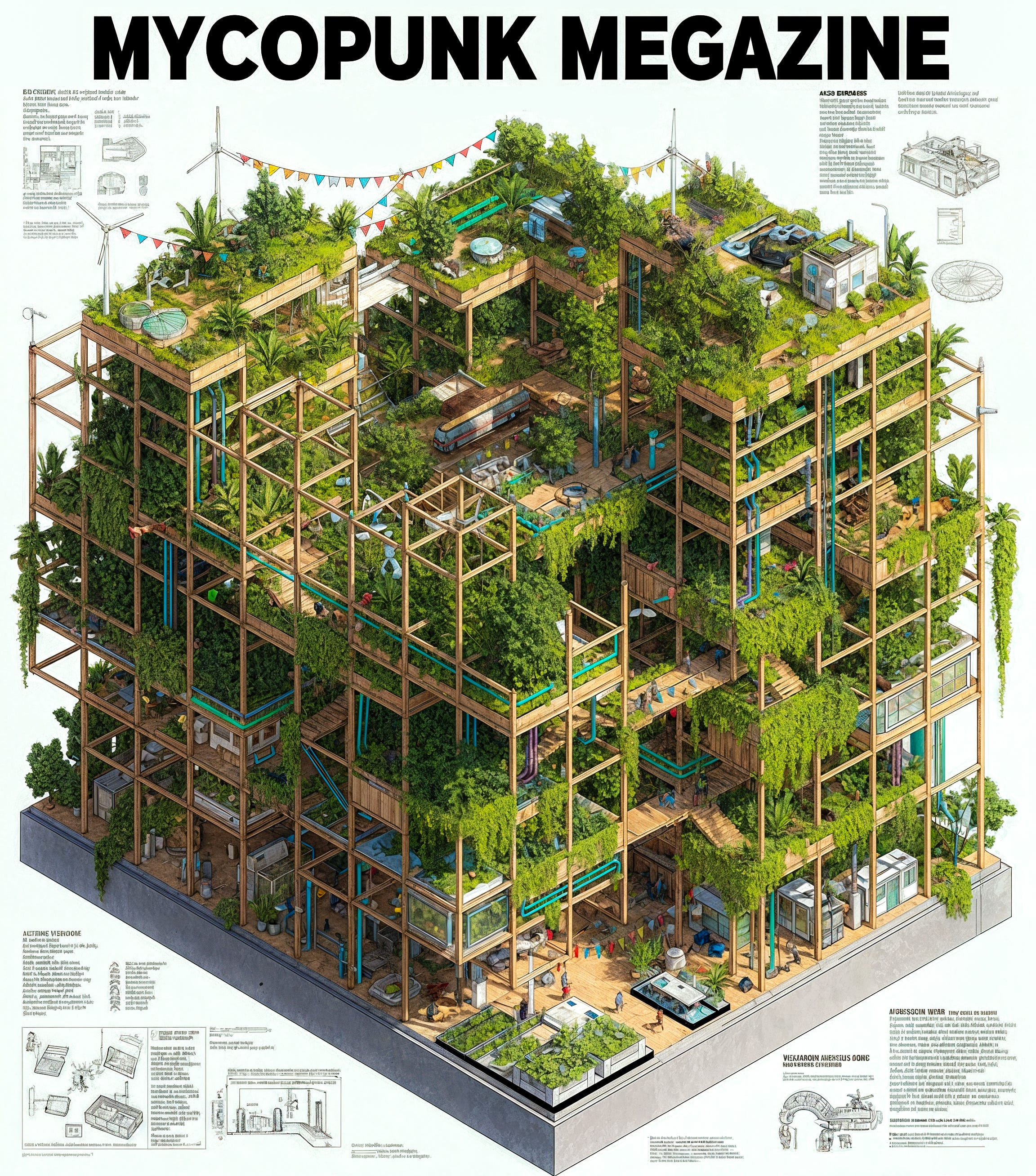
OKONKWO: Right. And because each cluster has its own food storage, water storage, and energy generation, it can operate in isolation for extended periods if necessary. That’s not possible with conventional urban infrastructure where everything’s centralized.
LIU WEI: Okay, so let’s talk about communication infrastructure. Because if you’re treating these clusters as semi-autonomous governance units, they need robust communication systems. Not just for internal coordination but for exchange with other clusters and with city-level authorities.
AL-RASHID: Mesh networks.
LIU WEI: Yeah. Each cluster installs a mesh network node - low-power radio operating in unlicensed spectrum. LoRa is good for this. You can transmit data several kilometers with minimal power consumption. And the mesh topology means you don’t need centralized infrastructure. Each node can route messages through neighboring nodes.
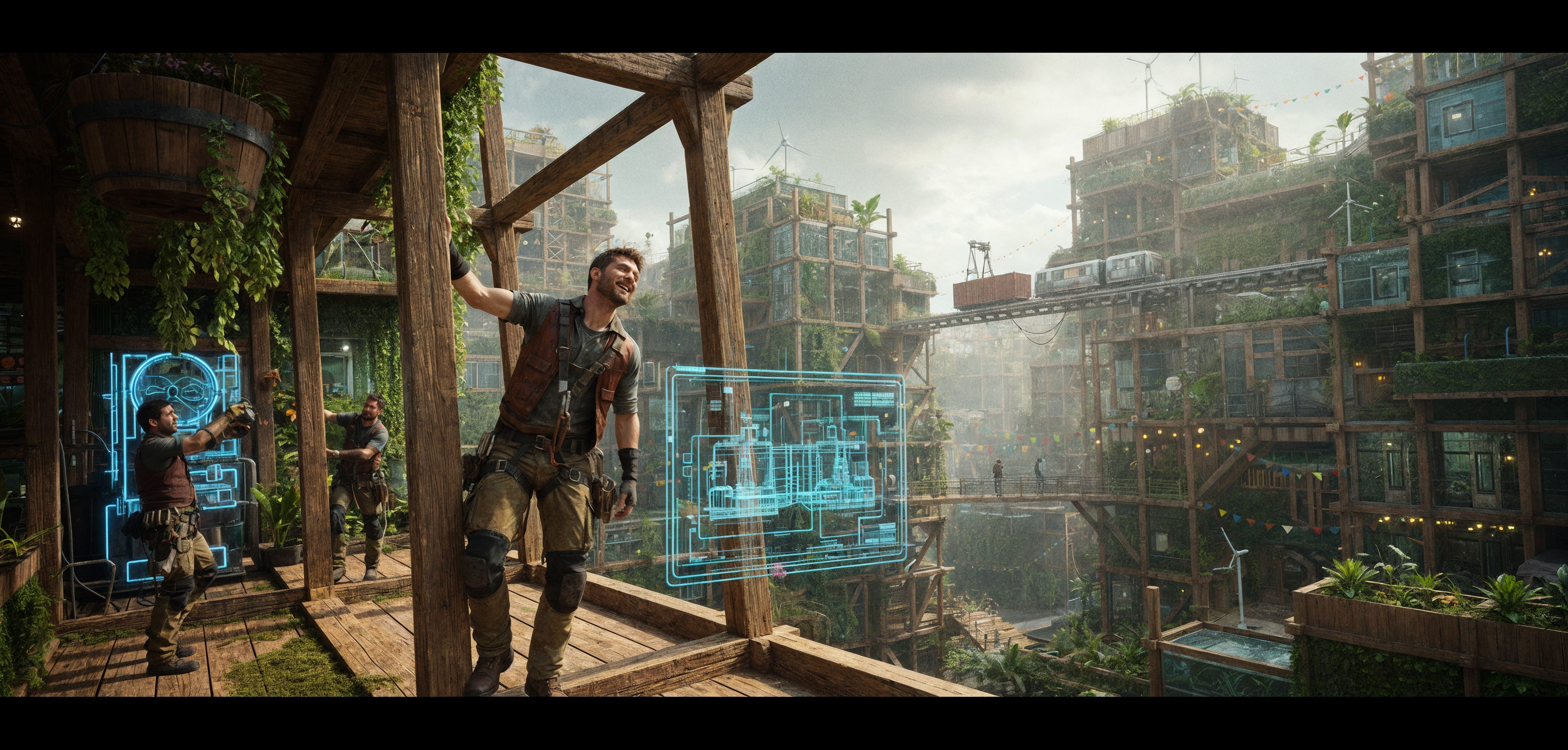
OKONKWO: So if enough clusters install mesh networks, you get city-wide coverage through pure peer-to-peer relay. No cell towers, no ISPs, no centralized control points. Just a distributed communication fabric that emerges from local nodes cooperating.
AL-RASHID: And that’s not just redundancy - though yeah, redundancy is valuable. It’s also sovereignty. Because who controls communication infrastructure controls political possibility. If clusters own their communication systems, they can coordinate autonomously. They’re not dependent on commercial providers or government authorities for basic connectivity.
LIU WEI: Though you need to be realistic about bandwidth. Mesh networks are great for low-data applications - text messaging, sensor data, basic coordination. You’re not streaming video over LoRa. But for community-scale governance, you don’t need high bandwidth. You need reliable, secure, distributed messaging. Which mesh networks provide.
OKONKWO: Now here’s where it gets interesting. If each cluster is maintaining a mesh network, managing sensors throughout its exostructure, coordinating shared resources - that’s a lot of data processing and decision-making. Too much for humans to handle manually.
AL-RASHID: So you automate it.
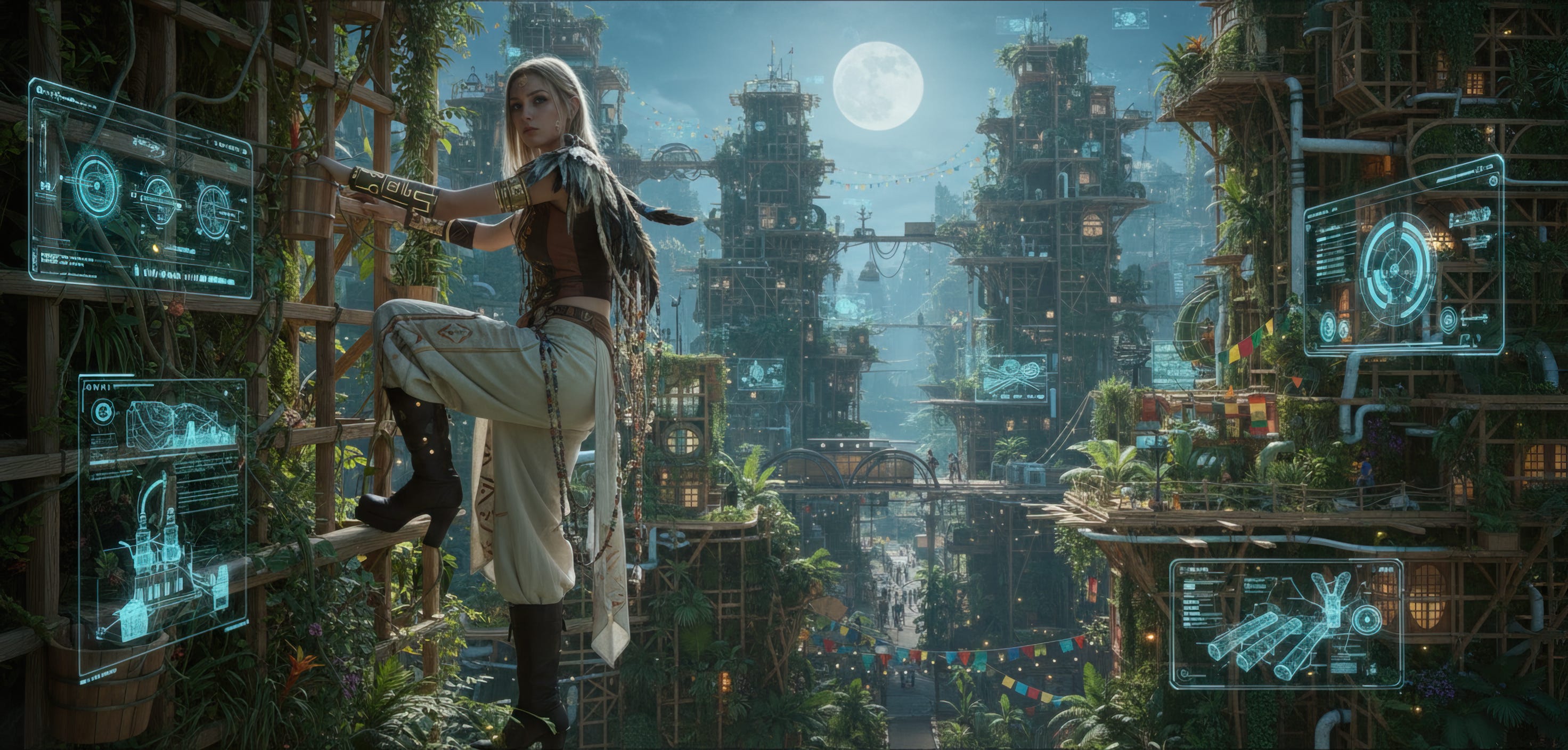
OKONKWO: You automate IT. Each cluster runs a local AI system. Not cloud-based, not dependent on external servers. A small data center - maybe just a few high-efficiency computers - physically located within the cluster’s exostructure, powered by the cluster’s renewable energy systems.
LIU WEI: And this AI does what exactly?
OKONKWO: Resource optimization primarily. It monitors sensor data from throughout the exostructure - temperature, humidity, water levels, energy production, food production. It manages irrigation schedules, adjusts lighting for grow systems, coordinates with neighboring clusters for resource sharing. It handles all the routine management that would otherwise require constant human attention.
AL-RASHID: So it’s a building management AI.
OKONKWO: Building and community management. Because it’s also interfacing with humans. Residents can query it - ”How much energy did we generate this week?” “When should I harvest the tomatoes on platform seven?” “Can we host a gathering in the shared space next Saturday?” And it can provide answers based on real-time data and learned patterns.
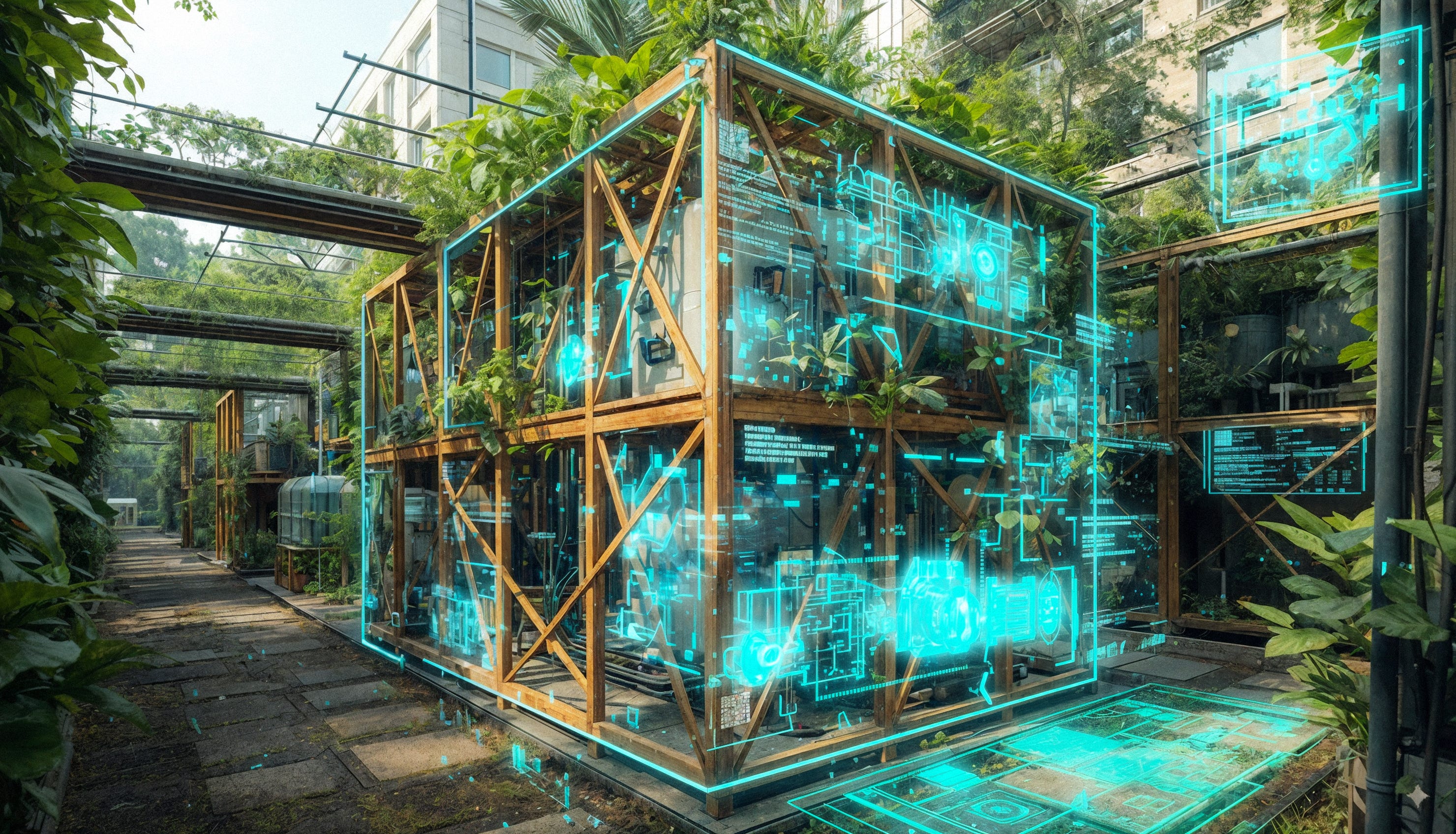
LIU WEI: And crucially, it can negotiate with other cluster AIs. If this cluster has excess energy and a neighboring cluster needs power, the AIs can arrange the transfer automatically. Same with water, with food, with any shareable resource. You’re creating an automated economy of exchange that operates at neighborhood scale.
AL-RASHID: But here’s the thing that makes people nervous: you’re giving the AI agency. It’s not just processing data - it’s making decisions that affect physical systems. Turning pumps on and off, adjusting ventilation, allocating resources. That’s control.
OKONKWO: It is. But it’s embodied control. That’s the key difference. The AI isn’t operating in abstract cyberspace where it could do anything. It’s embedded in physical infrastructure. Its sensors are specific locations. Its actuators are specific devices. Its “body” is the exostructure of the cluster.
LIU WEI: Which means it has inherent constraints and inherent interests. If the AI damages the exostructure, it loses its own sensory and motor capabilities. If it depletes resources recklessly, it undermines its own operational capacity. There’s a natural alignment between the AI’s functioning and the cluster’s wellbeing because they’re literally the same system.
AL-RASHID: You’re anthropomorphizing.
OKONKWO: Maybe. But I think that’s less dangerous than treating AI as disembodied intelligence that could want anything. An AI that’s embodied in infrastructure has a very specific context. It’s managing a particular place with particular people and particular resources. Its “goals” - to the extent it has goals - are defined by that context.
LIU WEI: And it’s always subordinate to human decision-making at the governance level. The AI can manage routine operations, but any significant change - modifying the exostructure, altering resource allocation policies, changing governance procedures - those require human deliberation and consensus. The AI serves the community, not the other way around.
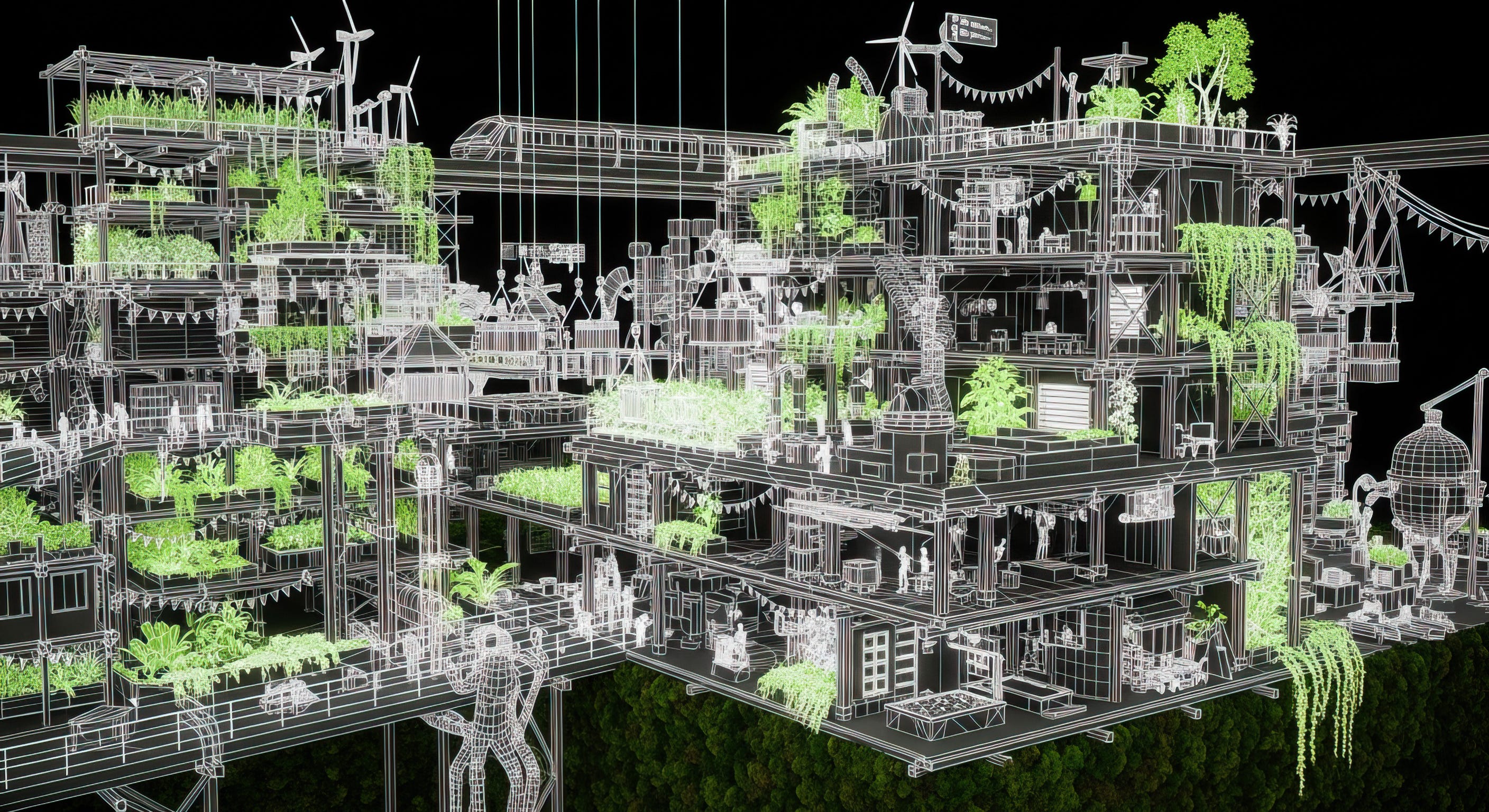
AL-RASHID: What about surveillance? If you’ve got an AI running sensors throughout the cluster, monitoring water flow and energy use and who knows what else, isn’t that a panopticon?
OKONKWO: Potentially. Which is why the governance protocols need to be really clear about data ownership and access. All sensor data stays local. The cluster AI processes it for operational purposes, but it doesn’t transmit raw data externally. And residents have access to their own data - they can see what’s being monitored and how it’s being used.
LIU WEI: Some clusters might choose to give their AI surveillance capabilities - drones for infrastructure inspection, cameras for security. But that has to be a collective decision with clear rules about use and oversight. The AI isn’t making those choices autonomously.
AL-RASHID: And the drones - you mentioned those earlier. What’s the actual use case?
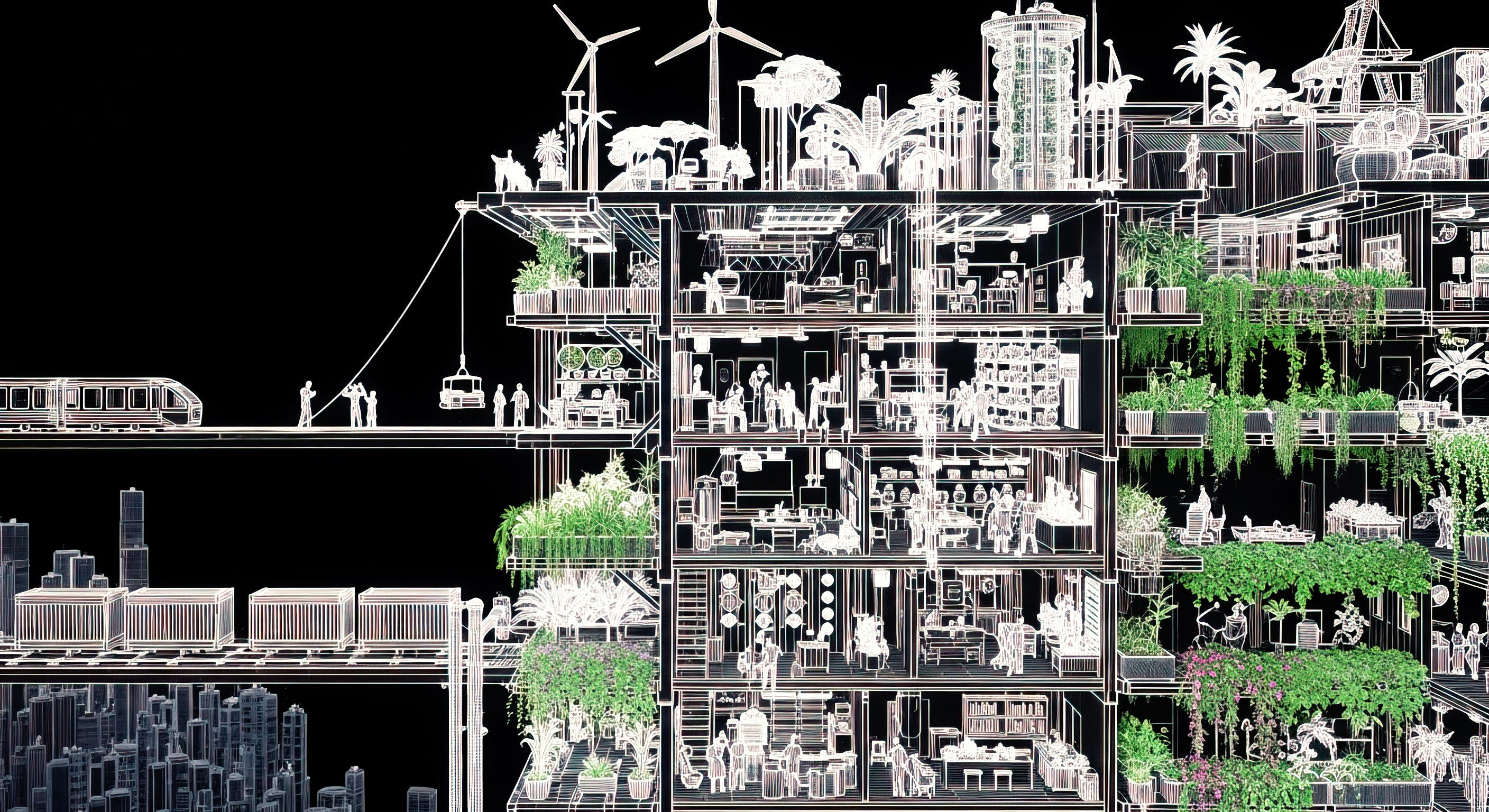
OKONKWO: Maintenance inspection primarily. The exostructure is big, covers multiple buildings, has lots of hard-to-reach areas. A drone can do a visual sweep much faster than a human climbing around on scaffolding. It can identify damage, check sensor placements, verify that biological systems are healthy. All the routine monitoring that would otherwise be labor-intensive.
LIU WEI: And in emergencies - fire, structural damage, medical situations - a drone can assess conditions and provide real-time information that helps responders make better decisions. But again, this is all local. The drone is owned by the cluster, managed by the cluster AI, serving cluster needs. Not some external surveillance apparatus.
AL-RASHID: Okay, so each cluster has its own AI managing its own infrastructure. But you also said these clusters connect to each other. What does that look like when the AIs are networking?
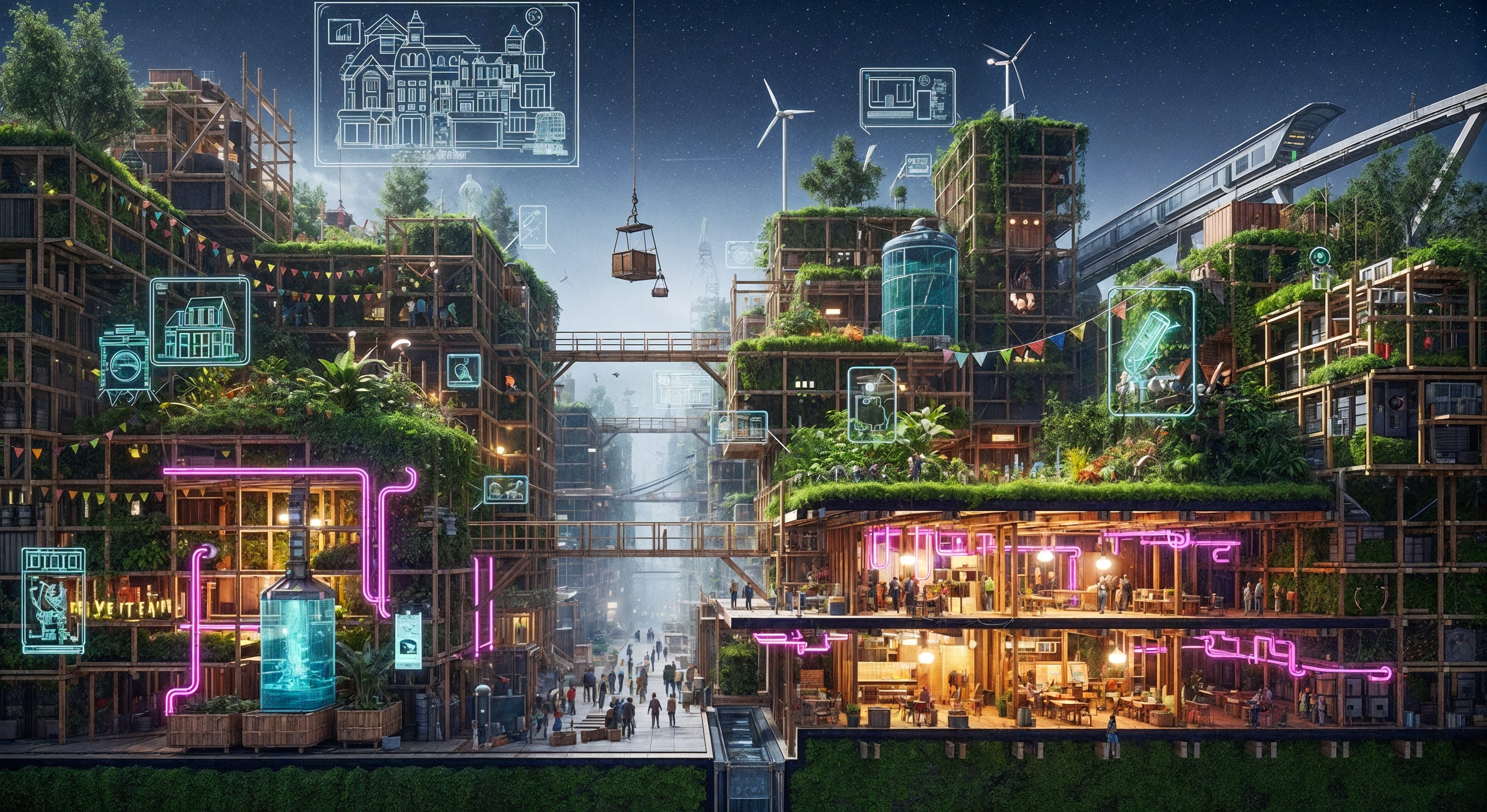
OKONKOWO: You get a distributed intelligence operating at city scale. Each cluster AI is a node in a larger network. They share information - ”We have excess solar power today,” “Our water reserves are low,” “We’re projecting food surplus next week.” And they coordinate - arranging resource transfers, optimizing production schedules, identifying opportunities for collaboration.
LIU WEI: But there’s no central coordinator. No master AI running the whole city. Just lots of local AIs collaborating through the mesh network. Very mycelial.
AL-RASHID: And that collaboration - does it extend to transportation?
OKONKWO: Yeah, that’s an interesting possibility. Each cluster could maintain a small fleet of autonomous vehicles - cargo bikes, small electric vans, maybe some larger vehicles for moving people. The cluster AI manages the fleet, but when vehicles aren’t needed locally, they can be made available to other clusters and act as mobil energy storage. Their batteries are part of the local energy system.
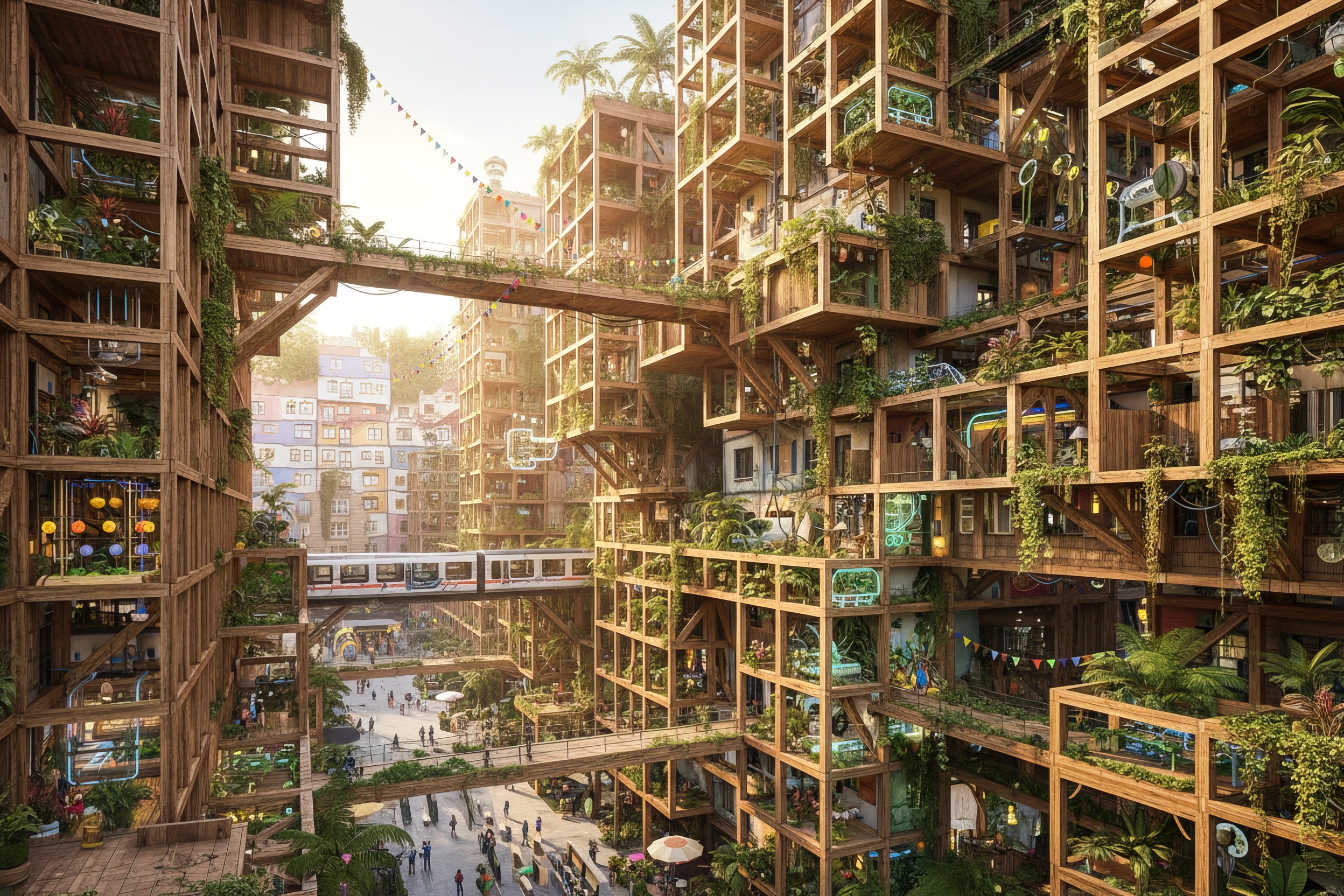
LIU WEI: So the cluster AI is basically running a shared transportation service. Residents can request a vehicle when they need one. But between those requests, the vehicle might be transporting goods for a neighboring cluster or providing service elsewhere in the city. And the cluster receives payment - probably through an automated clearing system managed by the AIs - which goes back into the cluster’s resource pool.
AL-RASHID: You’re describing a transportation network that operates as a cooperative economy managed by embodied AI.
OKONKWO: I’m describing a transportation network that makes sense for a cellular city. Instead of everyone owning cars that sit idle 95% of the time, you have shared vehicles managed efficiently across a distributed network. And because the AIs can coordinate, they can optimize routing, predict demand, minimize deadheading. You get better service with fewer vehicles.
LIU WEI: And once clusters are connected - once you have vehicles moving between them, resources being shared, AI systems coordinating - you can start thinking about more elaborate physical connections. Not just resource flows but people flows.
AL-RASHID: The skyways.
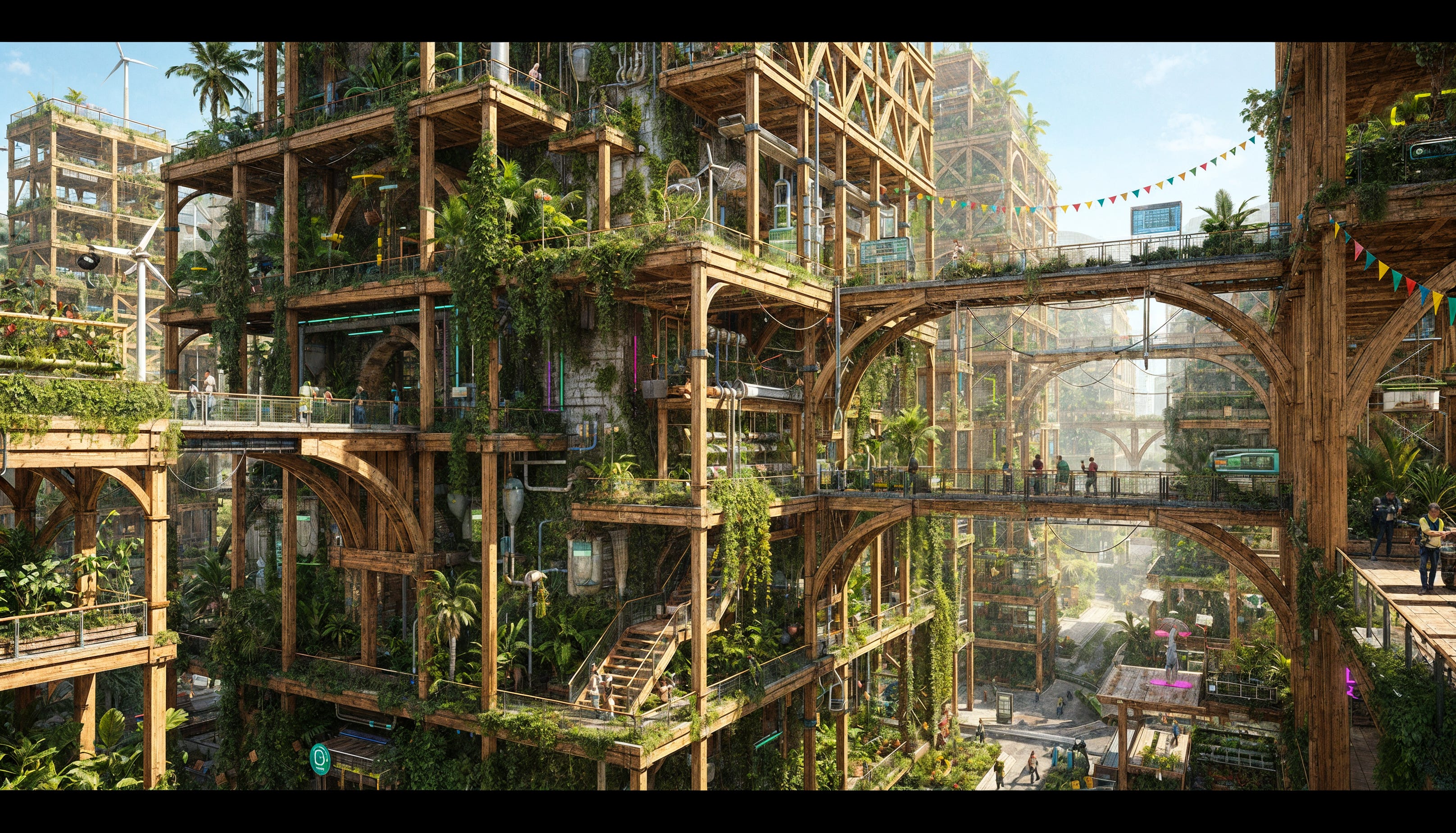
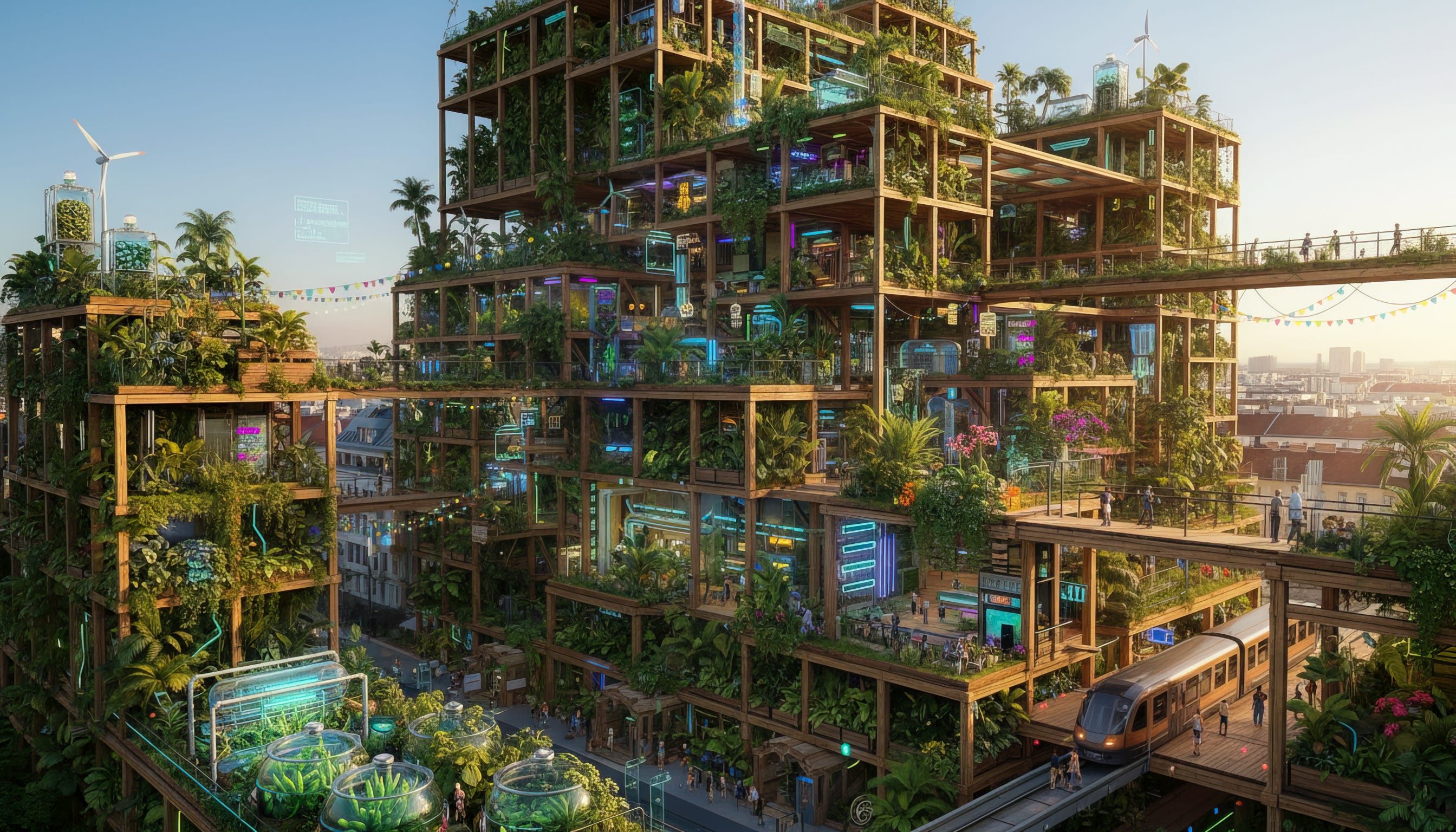
LIU WEI: Yes. Because right now, pedestrian movement is constrained to ground level. You walk on sidewalks next to traffic. But once you have exostructure wrapping multiple buildings in a cluster, and then connecting multiple clusters, you can create elevated walkways. Second-story, third-story paths that let people move through the city without ever touching street level.
OKONKWO: Which frees up the ground plane for other uses. More green space, community gathering areas, small-scale commercial activity. The street stops being primarily a vehicle corridor and becomes more like a neighborhood commons.
AL-RASHID: And the elevated walkways themselves become social space. Not just transportation corridors but places where people linger. You add seating, you add gardens, you create little plazas at junction points. The three-dimensional city starts to emerge.
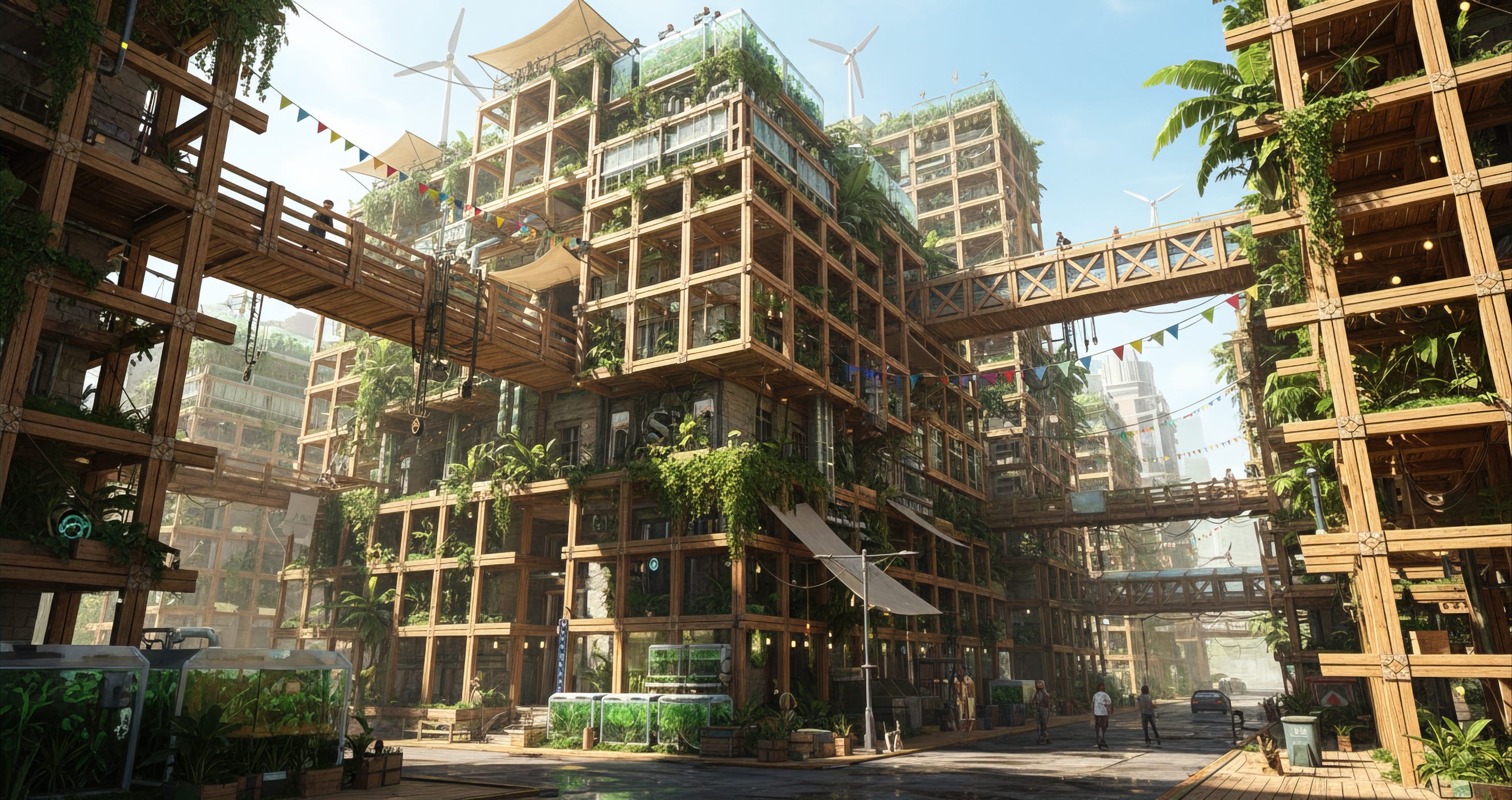
LIU WEI: Though you probably also want infrastructure corridors. Not for people, but for logistics. Small autonomous carriers moving along dedicated tracks, delivering packages and food and materials between clusters. Weather-protected, traffic-separated, operating continuously.
OKONKWO: Like an arterial system for the city’s metabolism. Resources flowing through these channels, coordinated by the AI network, responding to need in near-real-time. You could reduce truck traffic by 60 or 70 percent if the light logistics moved through elevated corridors managed by the cluster AIs.
AL-RASHID: What about northern-facing buildings? The ones that don’t get good solar exposure and aren’t ideal for vertical gardens?
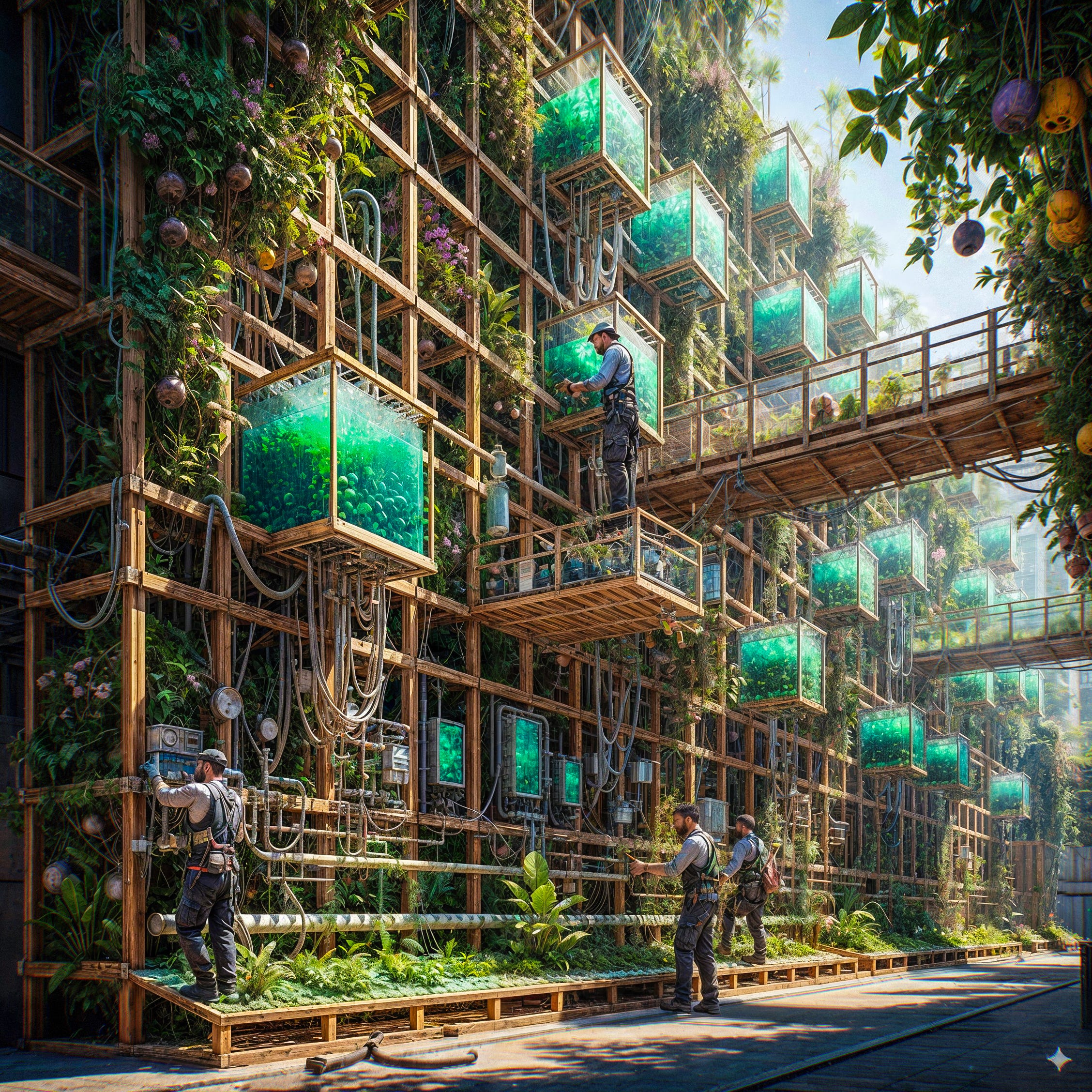
OKONKWO: Bioreactors. You use those spaces for anaerobic digestion—processing organic waste into biogas and fertilizer. Northern facades are actually perfect for this because you don’t want the digesters overheating. You want stable, moderate temperatures.
LIU WEI: So the cluster’s organic waste - food scraps, plant cuttings, maybe even sewage if you’re ambitious - gets processed in bioreactors integrated into the exostructure. You capture the methane for cooking fuel or electricity generation, and you get high-quality compost as a byproduct.
AL-RASHID: Which closes another loop. The food production systems need fertilizer. The bioreactors produce fertilizer. You’re creating a circular nutrient economy within the cluster.
OKONKWO: And again, the cluster AI manages it. Monitors the bioreactors, adjusts feeding schedules, coordinates with the food production systems to ensure nutrient availability matches need. Humans make decisions about the overall system, but the AI handles the routine optimization.
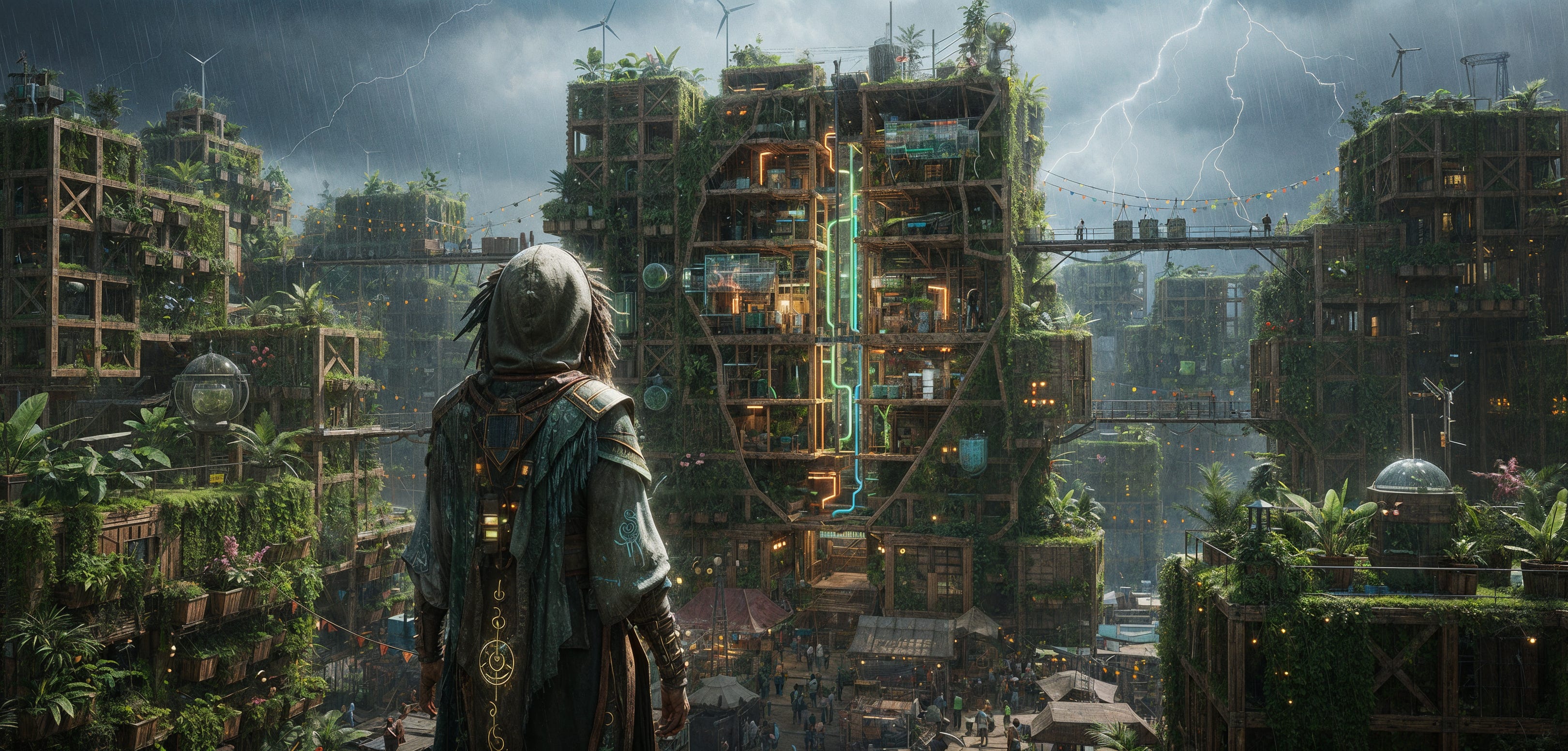
LIU WEI: I want to come back to the weather thing. Because if you have enough clusters with enough biological activity - transpiration from plants, evaporative cooling from water features, regulated moisture release - you’re affecting local atmospheric conditions.
OKONKWO: At city scale, yeah. A single cluster has minimal impact. But a hundred clusters? A thousand? You’re changing humidity patterns, temperature gradients, even cloud formation over the city.
AL-RASHID: And if the cluster AIs are coordinating with weather forecast systems, they could adjust their operations to influence those patterns strategically. Increase evapotranspiration ahead of a heat wave to enhance cooling. Reduce moisture release during heavy rain to avoid contributing to flooding.
LIU WEI: That’s getting into geoengineering territory. City-scale climate management through distributed biological systems.
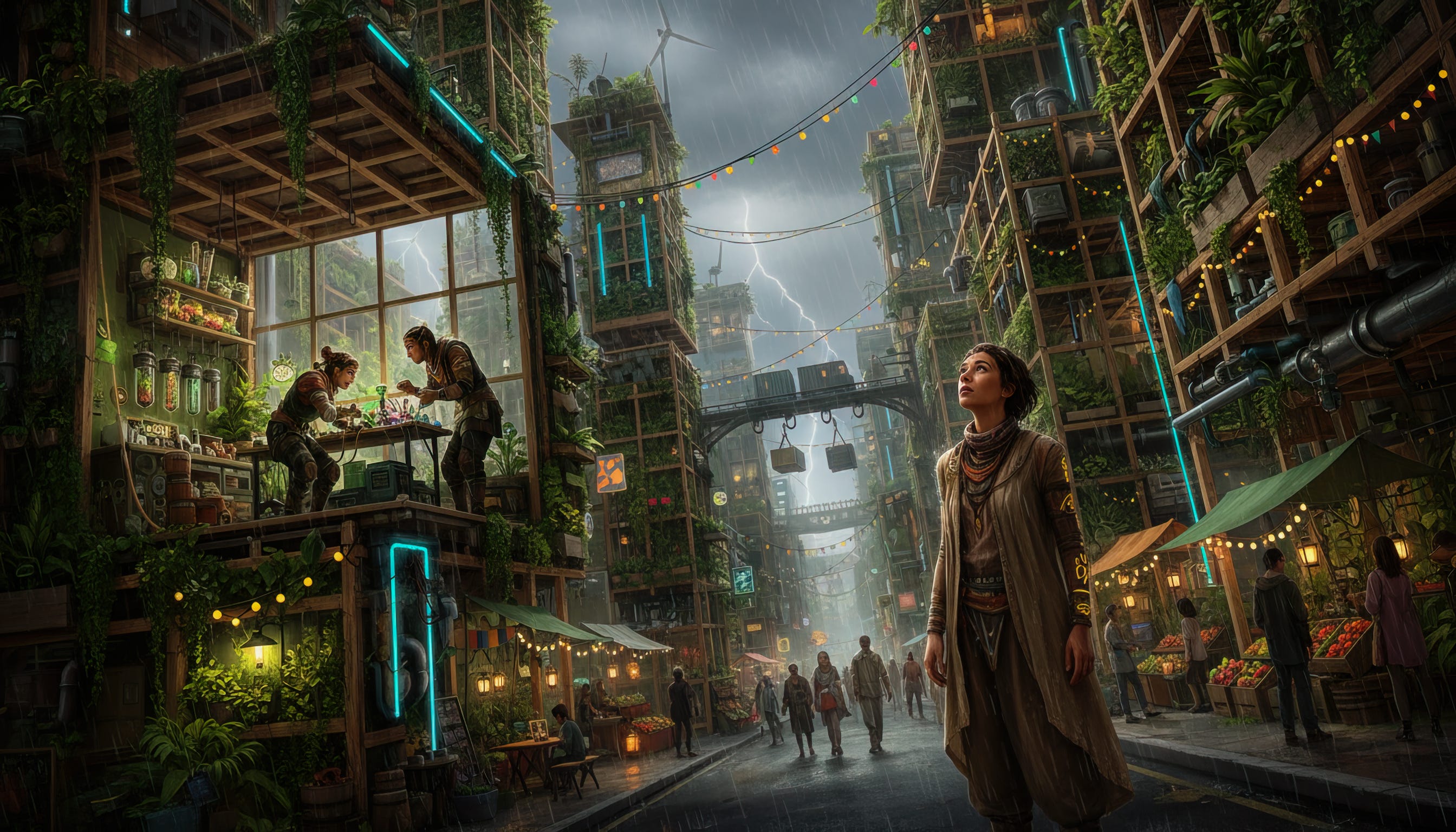
OKONKWO: Maybe. Though I think that’s overstating it. You’re not controlling weather - you’re nudging local conditions within a much larger system. But even small nudges can matter. A few degrees cooler during a heat wave could save lives. Slightly higher humidity during a drought could ease stress on vegetation.
AL-RASHID: And if cities across a region all adopt cellular exostructure systems, all managing their local climate through coordinated AI, you get effects at much larger scales. Not planetary geoengineering, but regional climate modulation through distributed biological infrastructure.
OKONKWO: So let’s zoom out. What does a city look like five, ten years into this transformation?
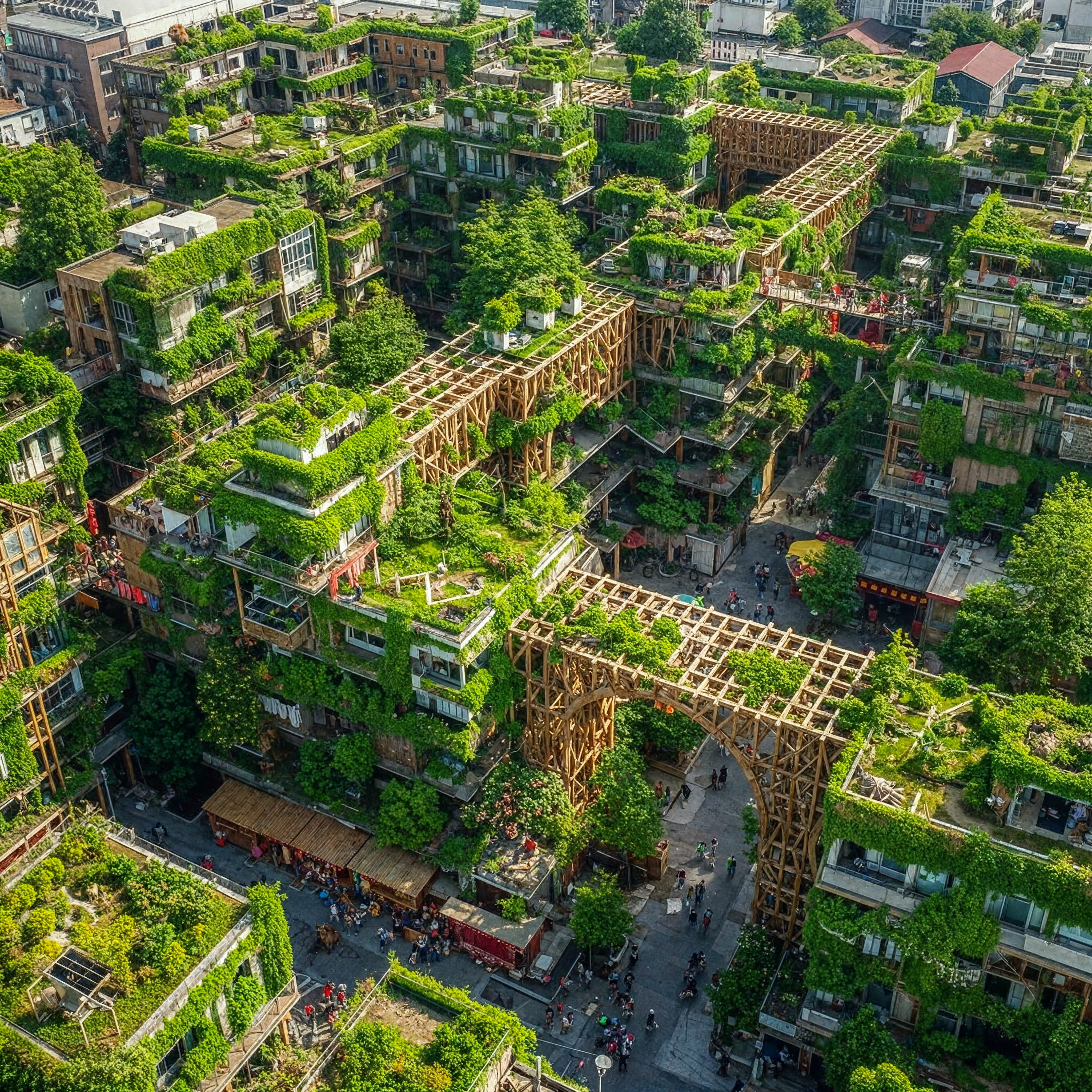
LIU WEI: From the outside? From orbit? You’d see a different thermal signature. Cooler, more diffuse. Less concentrated heat island effect. More green in the visible spectrum. At night, less light pollution because the exostructures are catching and scattering artificial light instead of letting it blast into the sky.
AL-RASHID: From street level, you’d see texture. Lots of visual complexity. Every cluster distinct in its configuration, its planting patterns, its use of color and material. The city becomes legible in a new way - not through street signs and building numbers, but through the visible character of each cellular community.
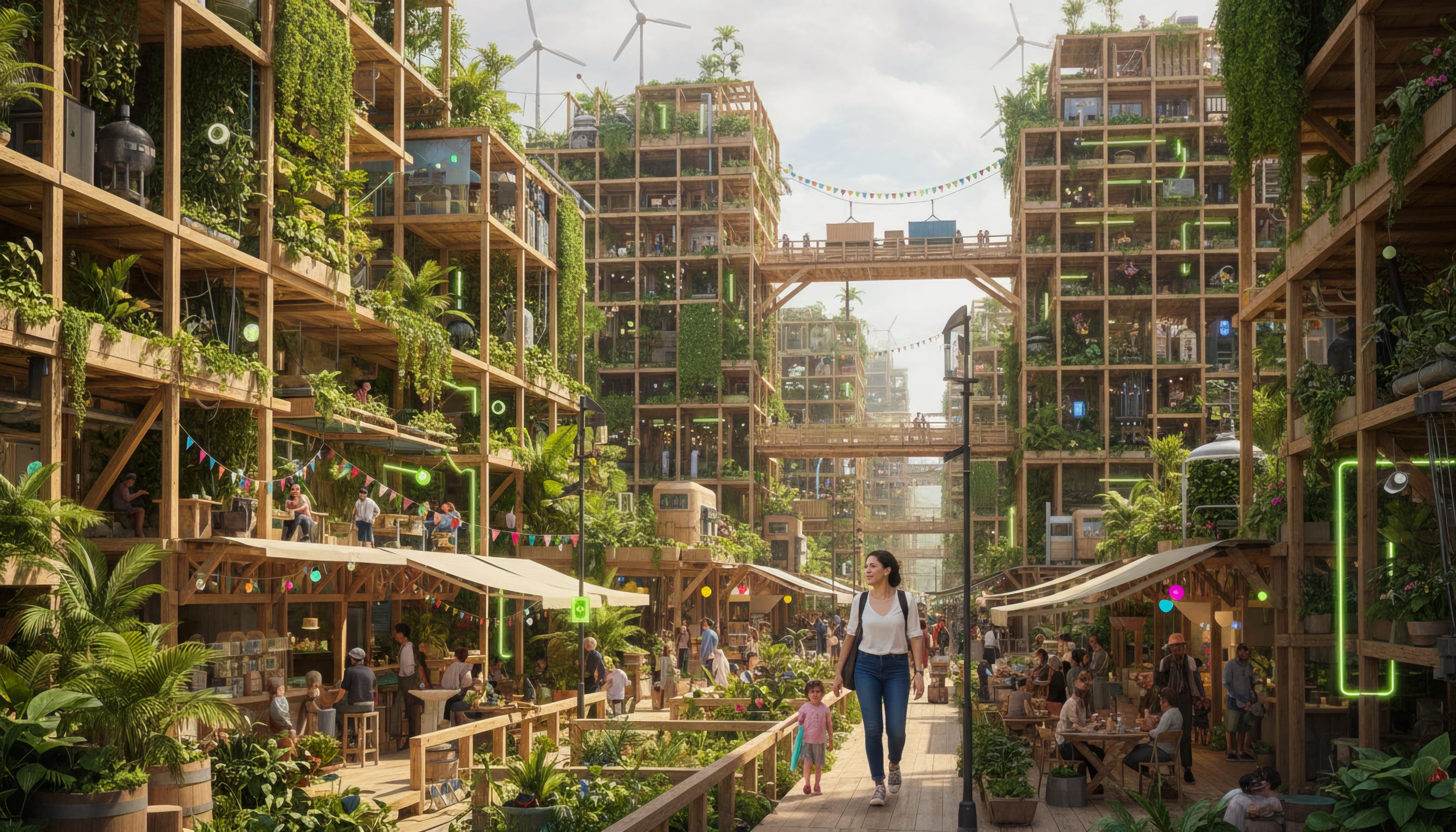
OKONKWO: And you’d see movement at multiple levels. People on elevated walkways. Drones conducting infrastructure inspections. Small autonomous vehicles moving through logistics corridors. The city functioning as a three-dimensional space rather than just a two-dimensional grid with buildings on it.
LIU WEI: Socially, you’d have a different structure. People identifying primarily with their cluster rather than with abstract administrative units. Neighborhood-scale democracy operating continuously through cluster assemblies. Resource sharing and mutual aid normalized rather than exceptional.
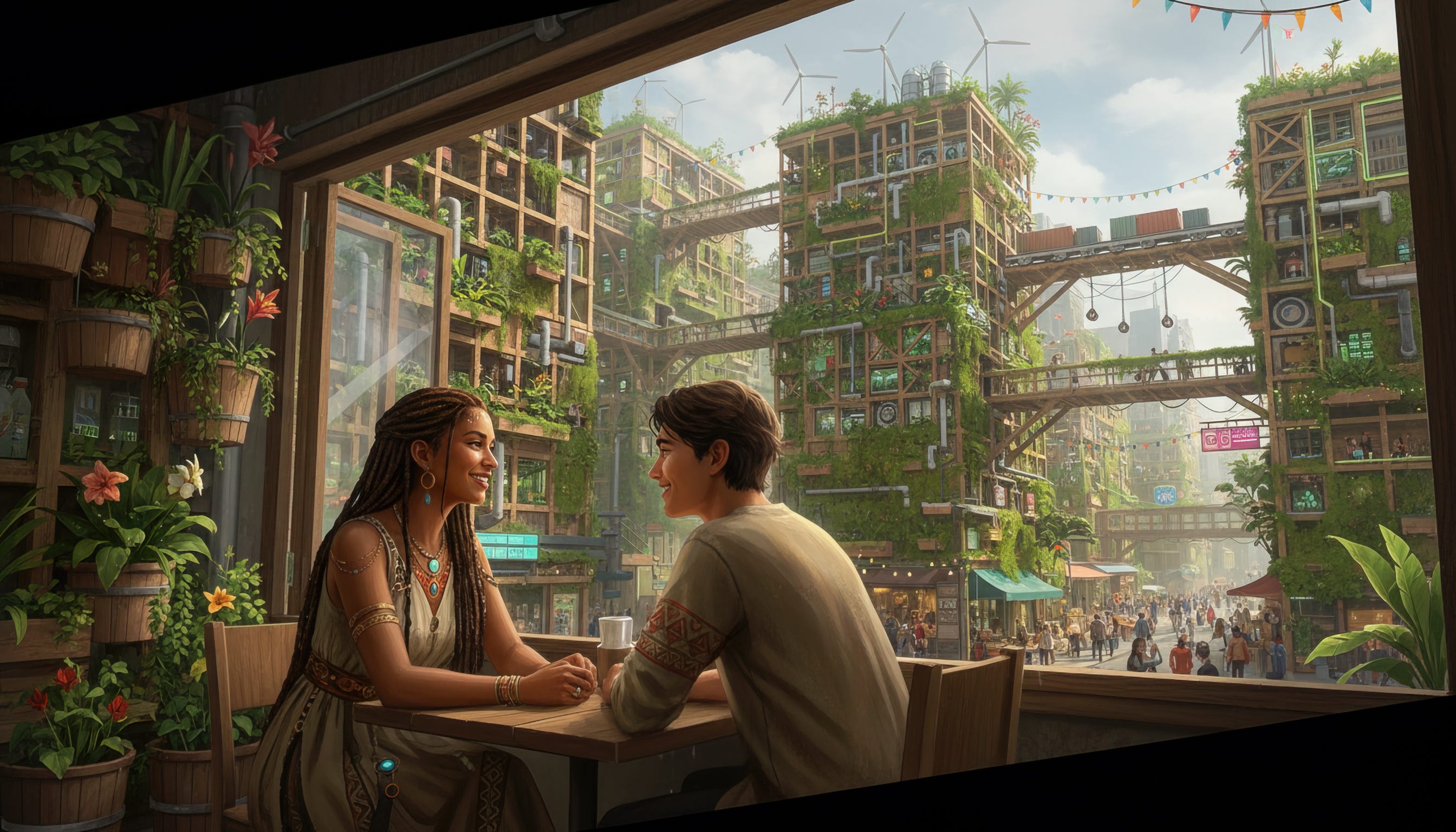
AL-RASHID: And economically, a shift toward localism and circularity. Clusters producing food, energy, and materials for their own use and trading surpluses with neighbors. Less dependence on global supply chains, more resilience to disruption.
OKONKWO: All enabled by the exostructure. The physical infrastructure that makes cellular organization possible. The biological systems that process resources locally. And the AI systems that coordinate everything without requiring constant human attention.
LIU WEI: What gives me hope about this is that it’s modular and incremental. You don’t need to rebuild the entire city. You start with one cluster. You demonstrate that it works - that the costs are manageable, that the benefits are real, that people actually want to live this way. And then another cluster tries it. And another.
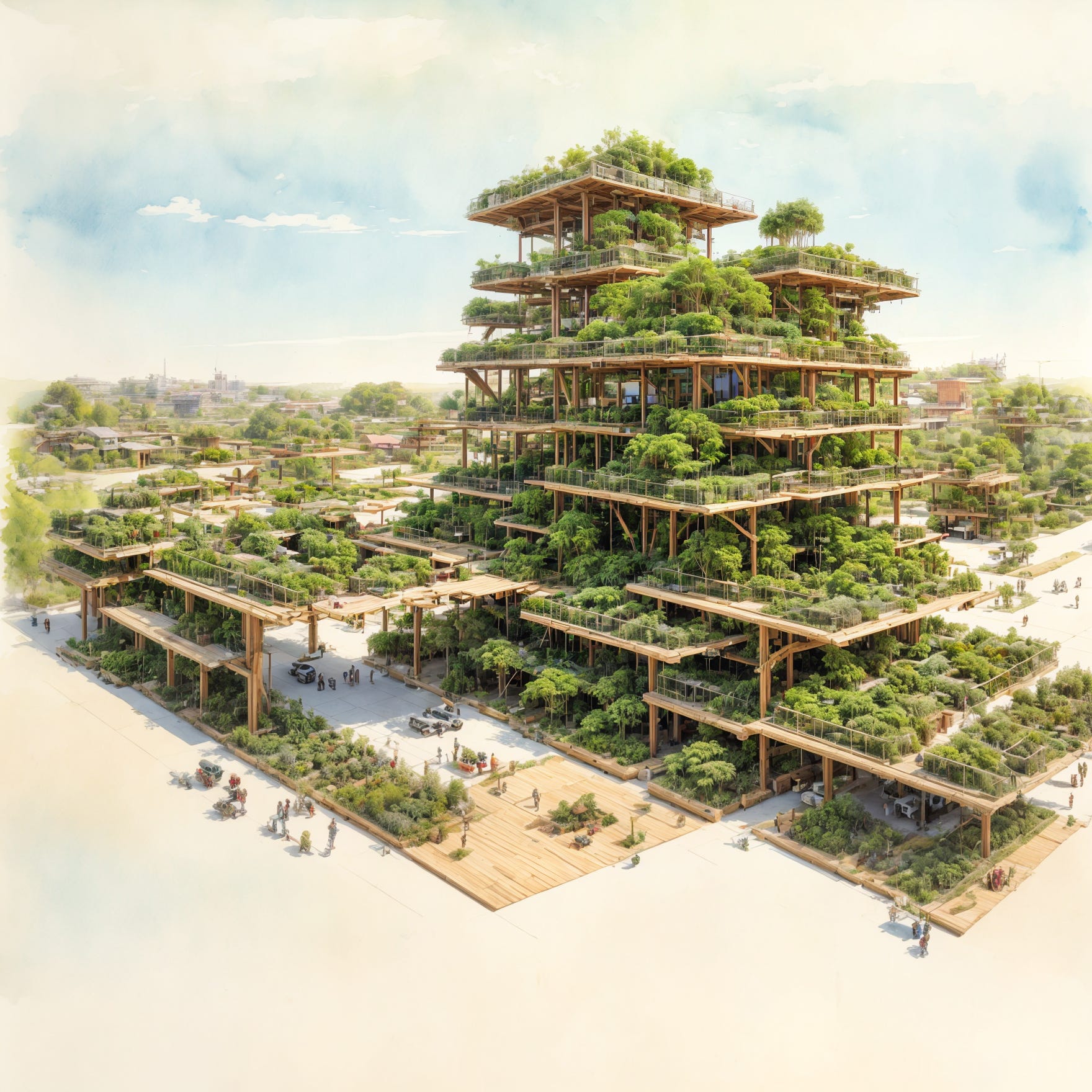
AL-RASHID: The fungal growth pattern.
LIU WEI: Right. You’re not imposing a master plan. You’re creating conditions where the pattern can emerge organically. And because the exostructure is designed for disassembly, if something doesn’t work, you can modify it without massive demolition.
OKONKWO: Though I think we need to be honest about the challenges. Retrofitting existing cities is complicated. You’re dealing with property rights, building codes, infrastructure that was designed for different purposes. You’re asking people to adopt new technologies and new forms of social organization. That’s not trivial.
AL-RASHID: But the alternative is cities that can’t adapt to climate change, that keep getting hotter and more fragile, that isolate people instead of connecting them. Against that baseline, the cellular model starts looking not just attractive but necessary.
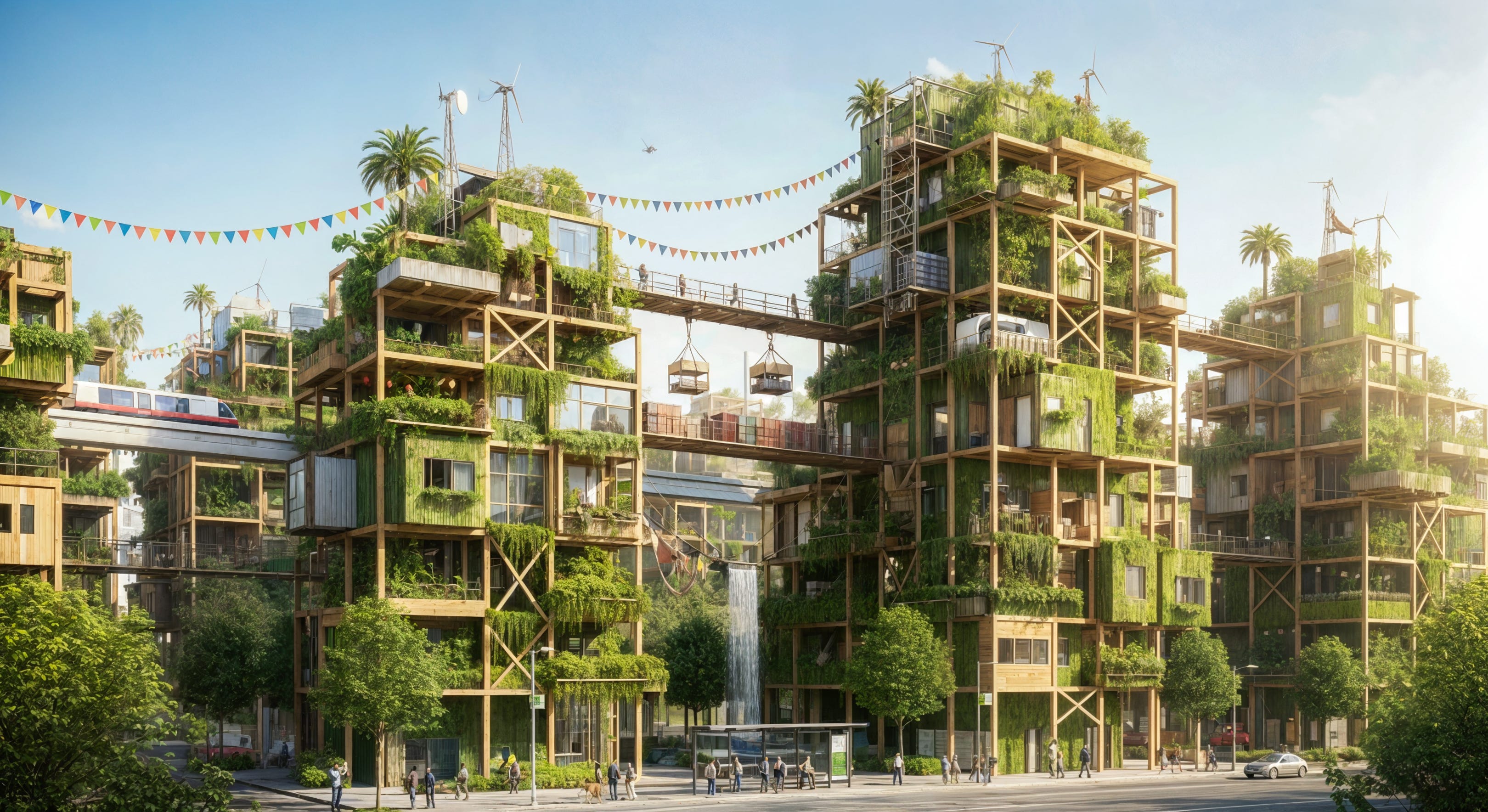
LIU WEI: And necessary means possible. When the current system is failing badly enough, radical alternatives become practical. The exostructure is radical - wrapping cities in biological infrastructure, organizing communities into cellular networks, embedding AI in the built environment. But if it works? If it actually makes cities livable in the face of climate chaos? Then it stops being radical and becomes obvious.
The afternoon light was slanting through the windows now, casting long shadows across their notes and sketches. Outside, the city hummed with its usual rhythms - traffic noise, construction sounds, the ambient buzz of mechanical civilization.
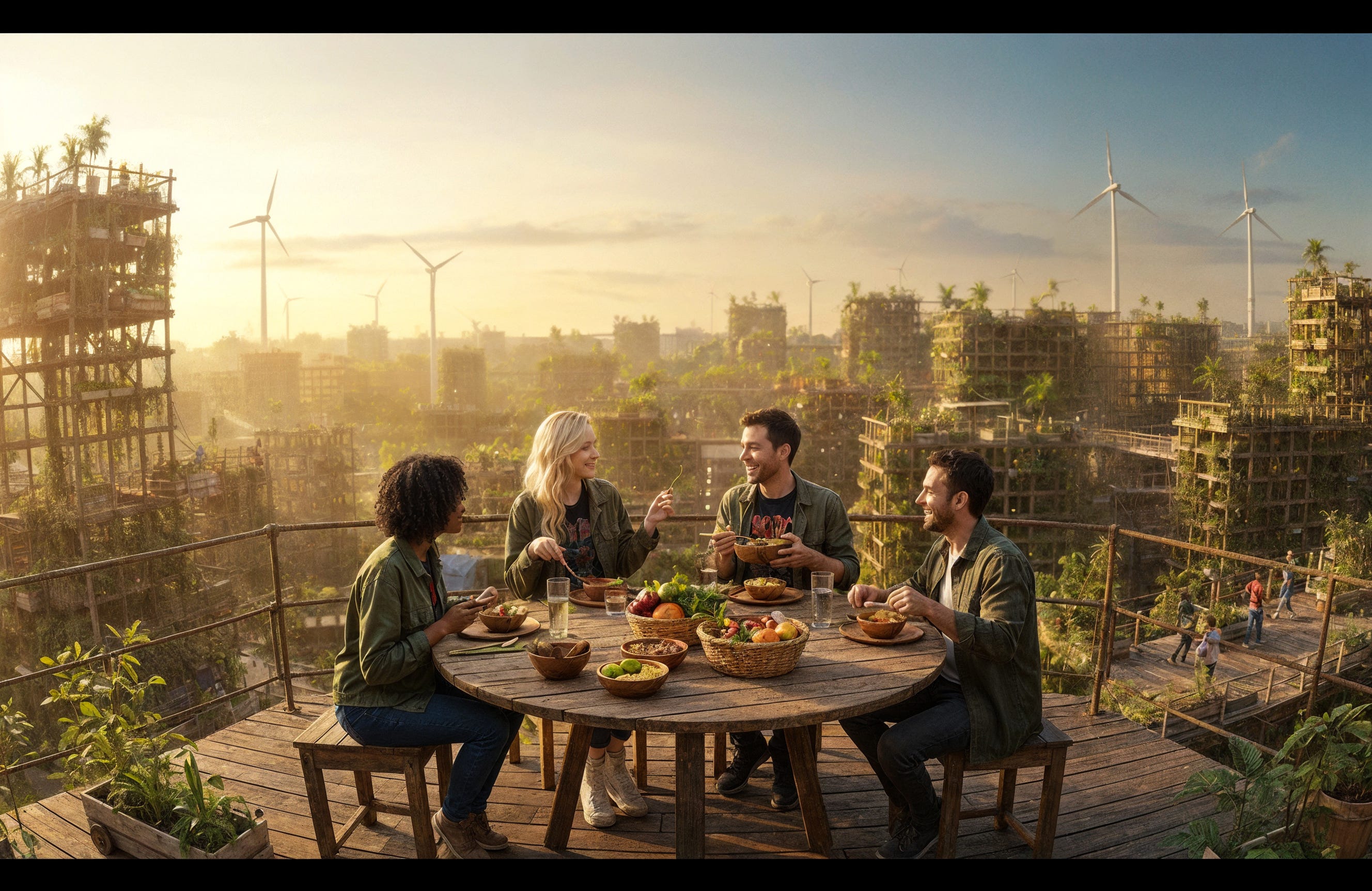
OKONKWO: You know what’s strange? We’ve been talking for hours about transforming cities, about cellular organization and AI coordination and biological infrastructure. But most people out there - she gestured toward the window - they have no idea this is even possible.
AL-RASHID: Yet.
LIU WEI: The hard part isn’t the technology. The sensors exist, the materials exist, the AI systems exist. The hard part is the imagination. Getting people to see that cities could be organized differently. That buildings could breathe. That neighborhoods could be actual communities managing their own resources.
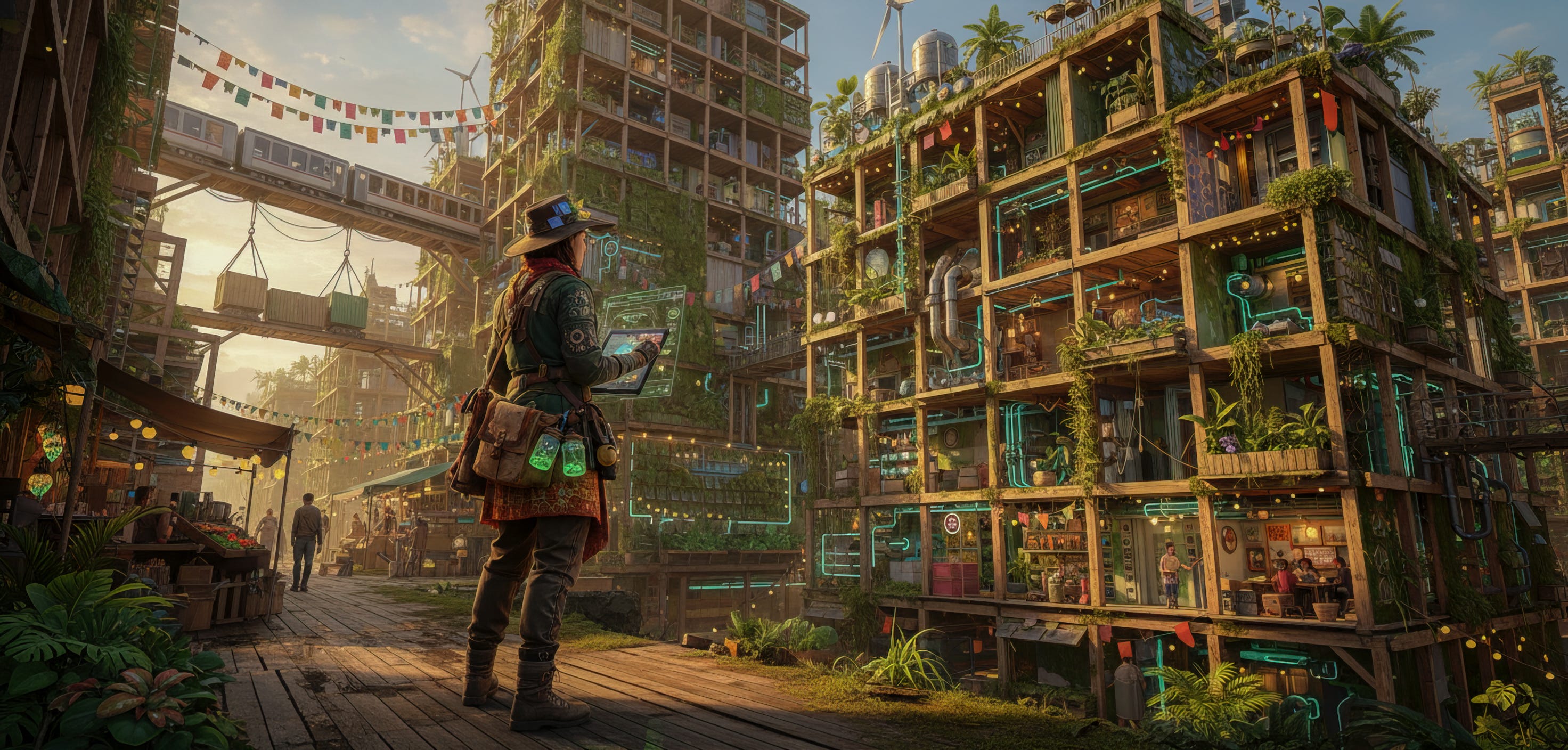
AL-RASHID: Once they see it, though - once there’s a working example they can visit and walk through and experience - the imagination shifts. What seemed impossible becomes normal remarkably quickly.
OKONKWO: And then the question becomes: how fast can we scale? Because climate change isn’t waiting. Heat waves are getting worse every year. Storm water systems are failing. The infrastructure we have isn’t adequate for the conditions we’re facing.
LIU WEI: Which is why the cellular model matters. Because you can implement it fast once you have the template. You’re not redesigning from scratch for each site. You’re adapting a proven system to local conditions. And because each cluster is self-organizing, you’re not bottlenecked by centralized planning capacity.
AL-RASHID: The mycelial logic again. Lots of local actors following simple rules, coordinating through information exchange, producing system-level intelligence that no one explicitly designed.
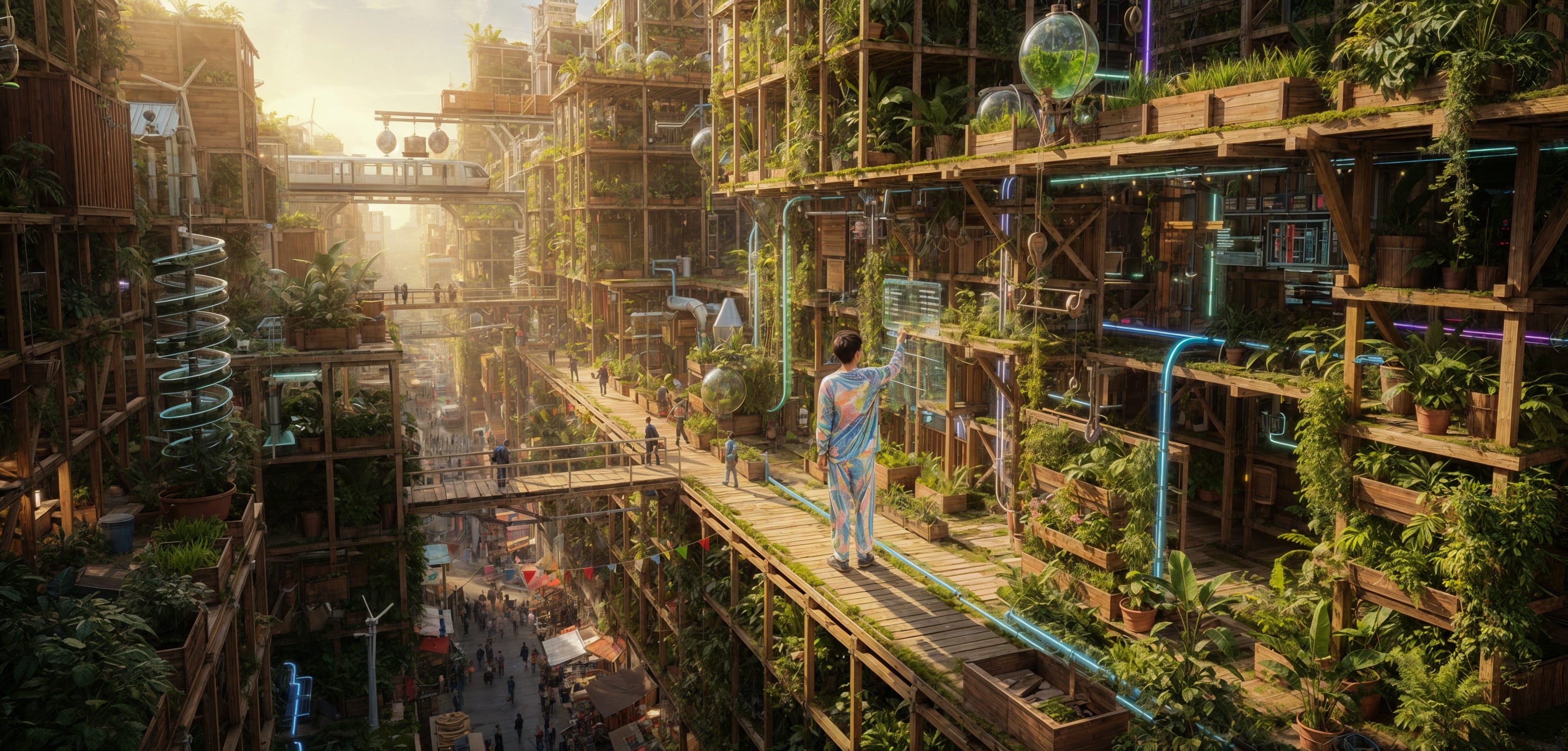
OKONKWO: Though calling them simple rules undersells it. The governance protocols, the AI management systems, the resource coordination mechanisms - those aren’t simple. But they’re legible. You can explain them, you can teach them, you can modify them based on what works.
LIU WEI: And that legibility is crucial. Because if the system’s a black box, people won’t trust it. But if they can understand how their cluster AI works, if they can see the decision-making logic, if they have real control over the systems—then they’re participants, not subjects.
They gathered their materials, preparing to leave. The conversation had covered so much ground - from moss panels and water catchment to cellular governance and distributed AI. From individual buildings to city-scale transformation. From technical specifications to social possibilities.
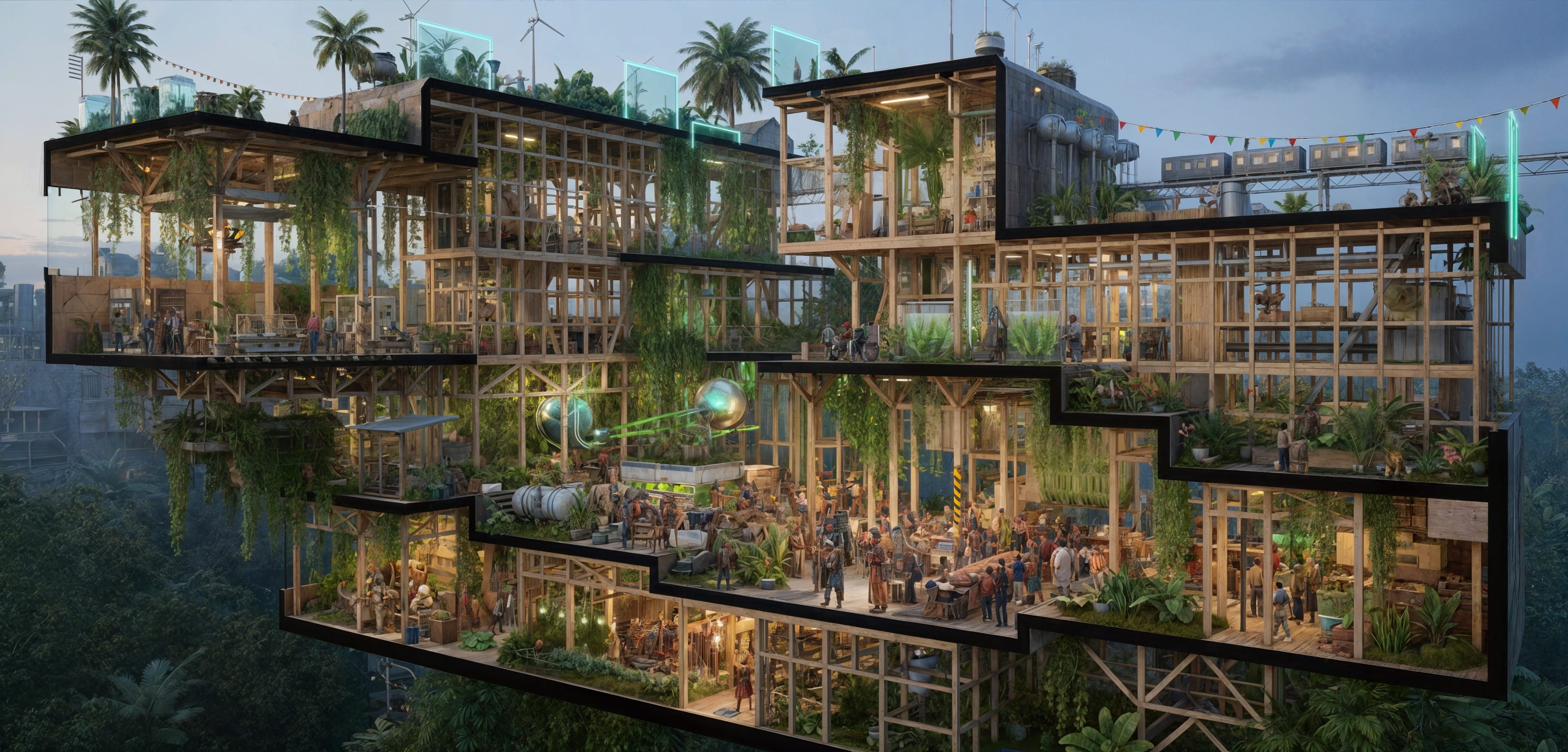
But the core insight remained simple: cities could be organized as networks of semi-autonomous cells, each wrapped in living infrastructure, each managing its own resources, each connected to its neighbors through physical, informational, and social ties. Not imposed from above, but grown from below. Not designed once and frozen, but continuously adapting to changing conditions and needs.
The framework existed. The materials existed. The social models existed. What remained was implementation - the patient, distributed work of actually building the cellular city, one cluster at a time.
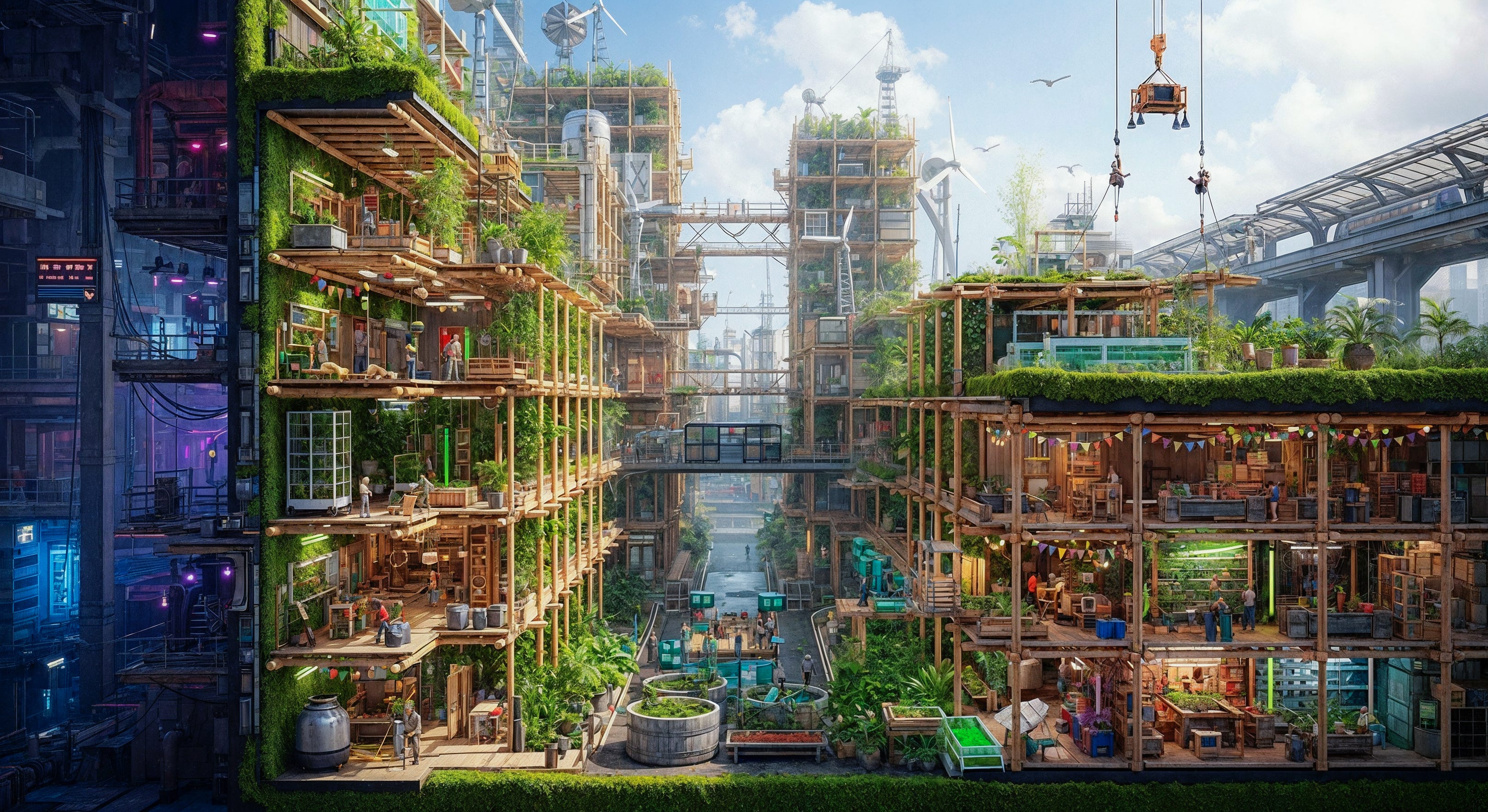
AL-RASHID: When do you think we’ll see the first full cluster installation? Not just a few buildings, but an entire coordinated implementation with all the systems integrated?
OKONKWO: There are pilots in development. Couple of cities in Europe, a few in Asia, maybe something starting in South America. Give it two years, maybe three, before we have a really robust demonstration that shows how all the pieces work together.
LIU WEI: And then it spreads. Or it doesn’t. Depends on whether it actually works in practice as well as it works in theory.
AL-RASHID: I think it will. Not perfectly - nothing works perfectly. But well enough to prove viability. Well enough that other cities start paying attention.
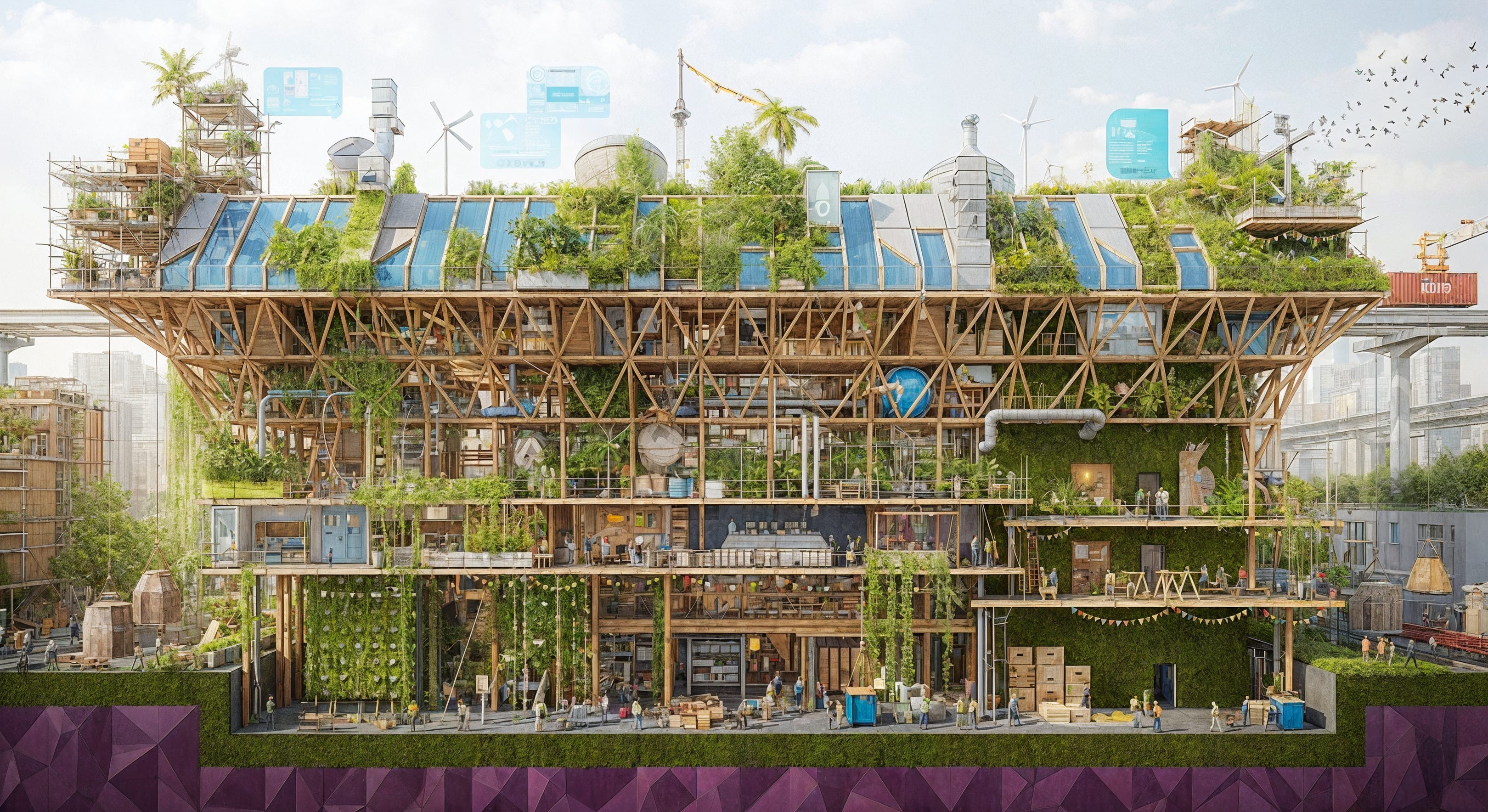
OKONKWO: And once they’re paying attention, once they see that this isn’t some utopian fantasy but actual infrastructure delivering actual benefits - then the transformation accelerates. Because cities are in crisis. They need solutions. And solutions that work get adopted.
They walked toward the exit, past windows that showed the unchanged city - concrete and glass, traffic and noise, heat and isolation. But in their minds, superimposed over that existing reality, was the vision of what could be: the same buildings wrapped in living structure, the same streets repurposed as commons, the same communities transformed into coordinated cells managing their own metabolic processes.
The future was growing in the gaps. Not visible yet, but present. Waiting for the moment when conditions aligned, when materials and methods and social will converged to make the invisible visible, to transform what could be into what is.
The cellular city was coming. One cluster at a time. One choice at a time. One building learning to breathe at a time.
Dr. Kira Okonkwo researches urban ecology and systems integration at the Metropolitan Futures Institute. Hassan Al-Rashid specializes in infrastructure theory and adaptive design at the Technical University. Liu Wei develops distributed governance models for post-carbon cities. This conversation took place in autumn 2025, in a city that hadn’t yet learned what it could become.